The Mystery of Julia Wallace’s Impossible Murder.
The "impossible murder" of Julia Wallace endures as a true-crime enigma, constructed with such precision that it rivals the most accomplished works of fiction. Raymond Chandler described it as the "nonpareil of all murder mysteries," noting it was "impossible, because Wallace couldn't have done it, and neither could anyone else." Dorothy L. Sayers observed that the tragedy "had no key-move and ended... in stalemate." This 1931 Liverpool homicide remains a historical puzzle, with evidence supporting two mutually exclusive conclusions.
The chain of events began not with a weapon, but a phantom phone call. On a dark January evening, someone posing as "R. M. Qualtrough" lured insurance agent William Herbert Wallace from his home with a business offer. The address was fake. While Wallace searched for it, his wife Julia, 69, was killed in their front parlour.
Upon Wallace's return, he discovered his wife beaten to death. The perpetrator had vanished, leaving Wallace without any trace of blood. The paradox is twofold: If Wallace committed the crime, how could a frail man inflict such violence, eliminate all evidence, and still catch his train on time? Conversely, if he was innocent, who orchestrated such a precise scheme to murder a quiet housewife while framing him so convincingly?
The enigma intensified during the legal proceedings. Wallace was convicted and sentenced to death, but the Court of Criminal Appeal, in a landmark decision, overturned the verdict and released him. The true perpetrator remained at large due to investigative shortcomings, perpetuating uncertainty. Continued analysis of forensic anomalies and suspects sustains the central question: Does the evidence indicate a calculating perpetrator or an innocent man who was framed?
A City of Routine, A House of Silence
In the winter of 1931, Liverpool was characterised by its working-class ethos and provincial atmosphere, marked by fog and lower-middle-class respectability. Among the red-brick terraces stood 29 Wolverton Street in Anfield, a modest residence occupied by the same unassuming couple for sixteen years.
William Wallace, aged 52, worked as a collections agent for Prudential Assurance and maintained strict routines alongside a reserved intellect. Despite chronic illness, he engaged in solitary pursuits such as chemistry, botany, chess, and the study of Marcus Aurelius. Julia, an amateur musician and painter, concealed her true age by claiming to be significantly younger.
To outsiders, the Wallaces appeared unremarkable yet close-knit. Childless and reclusive, Wallace stated, "Neither of us cared much for entertaining; we were sufficient in ourselves." Their domestic life was characterised by quiet routines, including tea and scones, followed by Julia at the piano and William on the violin.
Their household was notably quiet, with neighbours reporting no discord despite the thin walls. The Wallaces' unremarkable daily existence contributes to the case’s unresolved character. There were no known extramarital affairs, significant financial difficulties, or grievances. The frail husband and reserved wife led a highly predictable life, which was suddenly disrupted by extraordinary violence.

The Call at the Chess Club
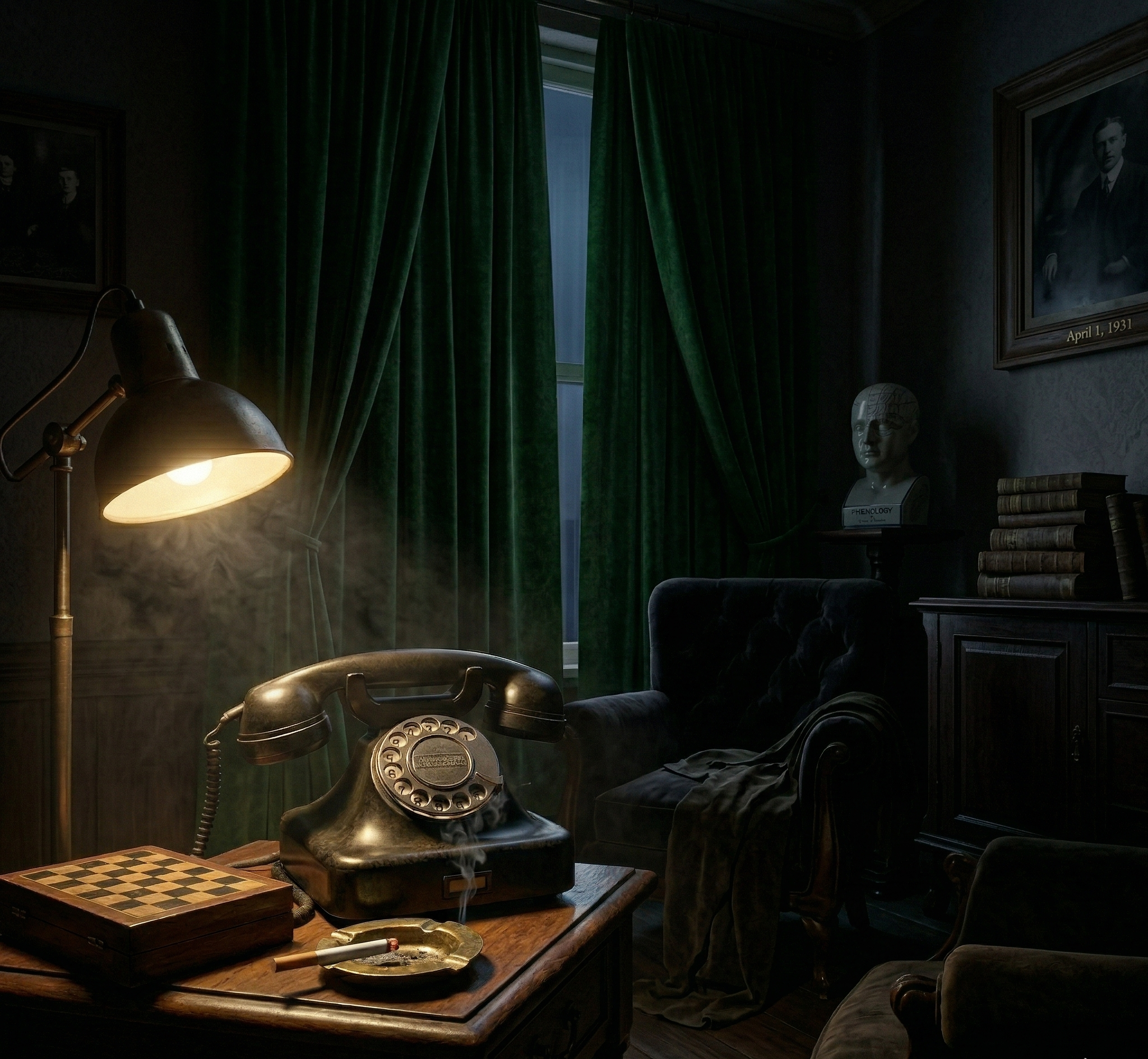
On Monday evening, 19 January 1931, the Wallaces' routine broke. Just after 7:15 PM, William Wallace left 29 Wolverton Street for the Liverpool Central Chess Club in the basement of Cottle's City Cafe. At 7:20 PM, before Wallace arrived, the cafe phone rang. Club captain Samuel Beattie answered. The caller, in a gruff voice, asked for Wallace, refused to ring back, and left a specific message: Wallace was to visit at 7:30 PM the next evening for an endowment policy—name "R. M. Qualtrough," address 25 Menlove Gardens East, Mossley Hill.
Wallace arrived twenty-five minutes later, at which point Beattie relayed the message. Expressing confusion, Wallace stated he was unfamiliar with Qualtrough or Menlove Gardens East but expressed interest in the potential commission. He recorded the details, discussed possible tram routes with others, and then played his match.
This unusual phone call constitutes the pivotal element of the "impossible murder." Absent this call, Julia Wallace's death might have appeared to be a burglary gone awry. The Qualtrough message suggested premeditation. Police traced the call to a public kiosk, Anfield 1627, located only 300 to 400 yards from Wallace's residence.
This fact divided the case into two primary theories. The prosecution argued that Wallace made the call himself en route to the cafe, disguising his voice to deceive his club captain and establish an alibi. Alternatively, if Wallace was innocent, the true perpetrator was an individual with intimate knowledge of Wallace's routine—possibly obtained from the chess club noticeboard—who lured him away, leaving Julia defenceless.
The Address That Didn’t Exist
On Tuesday, 20 January, William Wallace departed his Anfield home at 6:45 PM. Subsequently, detectives and true-crime historians scrutinised every detail of his journey. He took three trams across Liverpool to Mossley Hill. For a typically reserved individual, his behaviour was uncharacteristic: he informed nearly every tram conductor of his destination and asked for directions to "Menlove Gardens East," telling one guard, "I am a stranger here."
Wallace arrived at Mossley Hill at 7:20 PM and walked into a trap. Menlove Gardens was divided into North, South, and West—no East. Hoping for a commission, Wallace kept searching in the cold, knocking at 25 Menlove Gardens West. The residents knew nothing of Qualtrough.
As the evening progressed, Wallace’s search for an individual at a nonexistent address appeared increasingly deliberate. He interacted with multiple individuals, thereby ensuring his presence was observed. He sought advice from Sidney Hubert Green and later spoke to a police officer on Green Lane, recounting the chess club phone message. During this conversation, Wallace checked his pocket watch and remarked, "It is not 8 o'clock yet." He subsequently visited a local newsagent to consult a street directory, then abandoned the search and returned home by tram.
This conspicuous and public search reinforced police suspicion. To investigators, Wallace's actions appeared less as the frustration of a confused businessman and more as a calculated performance intended to establish an alibi. His "stranger" persona was undermined when it was discovered that his Prudential manager resided on Green Lane, a street Wallace visited that night and knew well from previous violin lessons and business activities. To the prosecution, Wallace was not a victim deceived by a prankster, but rather a mastermind ensuring his public visibility while his wife was being murdered elsewhere.
The Body in the Parlour
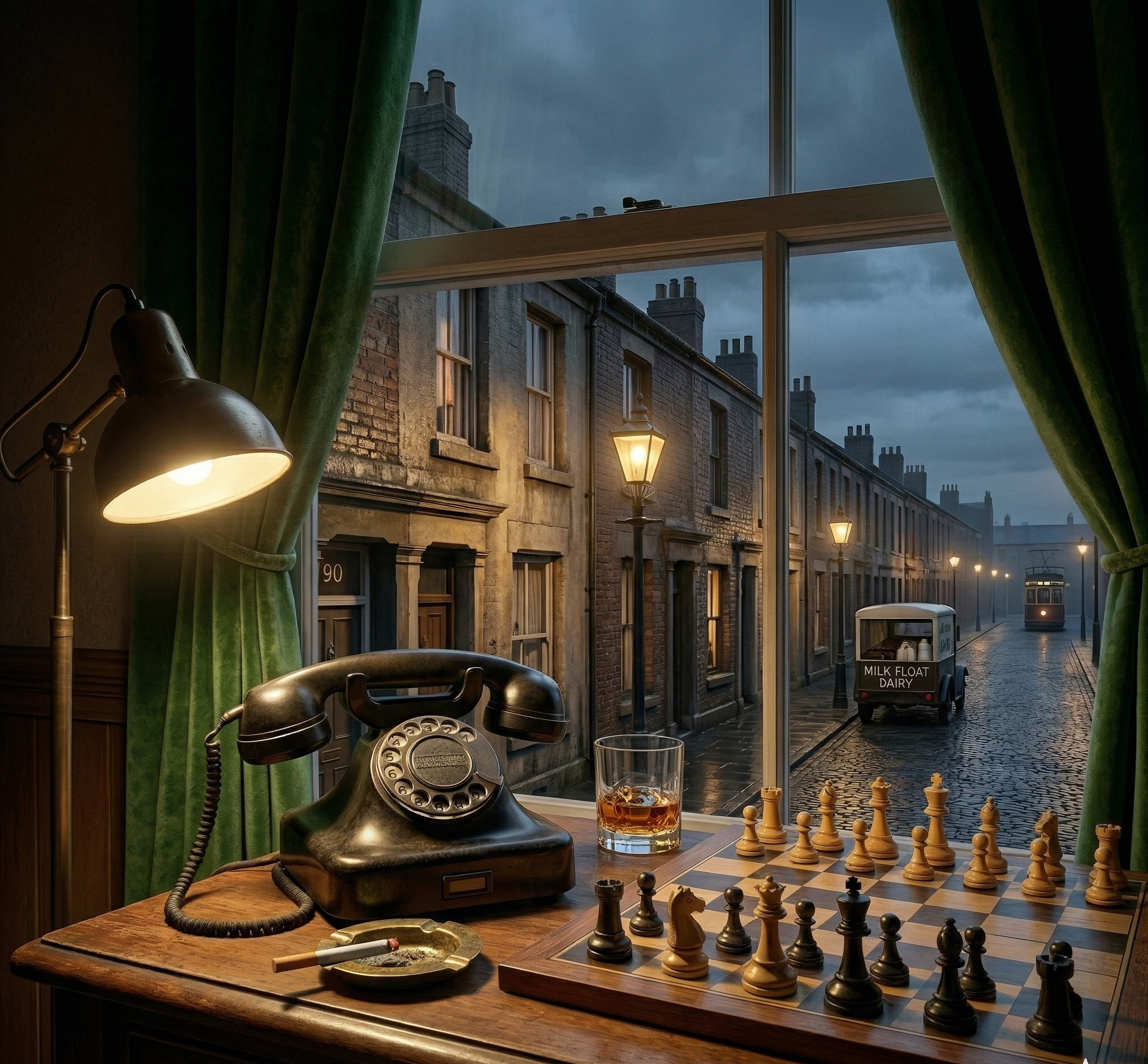
William Wallace returned to Wolverton Street at about 8:45 PM. The house, usually quiet and domestic, was now in total darkness. Wallace tried his key in the front door, but it would not open. He went to the back entry. The yard gate stood open, but the back door was bolted. Confused, he circled the house and met his neighbours, John and Florence Johnston, who were leaving for the evening.
Wallace explained his predicament and said softly, "She won't be out, she has such a terrible cold." At John's urging, he tried the back door once more. Suddenly, the handle turned. "It opens now," Wallace said, slipping inside while the Johnstons waited. They watched the lights flicker on as Wallace called, "Julia?" twice into the gloom. Moments later, he came out, his composure gone, and cried, "Come and see! She's been killed!"
Upon entering the front parlour—the room previously reserved for peaceful musical evenings—the Johnstons encountered a scene of unimaginable horror. Julia Wallace lay dead on the rug, her head crushed by what was later determined to be eleven blows from a blunt instrument. The ferocity of the attack had projected blood and brain matter up to seven feet on the wallpaper, transforming a space of domestic routine into a site of violence. Despite the brutality, the room's furniture remained undisturbed, presenting a stark contrast to the scene on the floor. As Florence Johnston looked on in shock, Wallace approached his wife's body and noted a peculiar detail: beneath her lay his own blood-soaked mackintosh, which he had worn earlier that day. "Why, whatever was she doing with her overcoat, and my raincoat?" he asked quietly, bewildered.
The remainder of the house provided little additional explanation. A kitchen cupboard had been forced open, and Wallace's insurance cash box was missing approximately four pounds, while a spare bedroom upstairs was inexplicably ransacked. However, no weapon was ever recovered, and the perpetrator left no trace of blood outside the parlour. In a matter of hours, a quiet, unremarkable existence was extinguished, leaving behind a locked-room mystery that would perplex investigators for decades.
The Husband, the Alibi, and the Narrow Window
When William Herbert Wallace stood trial for his life, the prosecution presented a theory of chilling, calculated premeditation. They argued that the entire "Qualtrough" saga was an elaborate fiction authored by Wallace himself to secure a watertight alibi. According to the Crown, Wallace stopped at the Anfield 1627 telephone kiosk—located just 400 yards from his front door—on his way to the chess club on Monday night, disguised his speech, and laid the trap that would justify his absence the following evening.
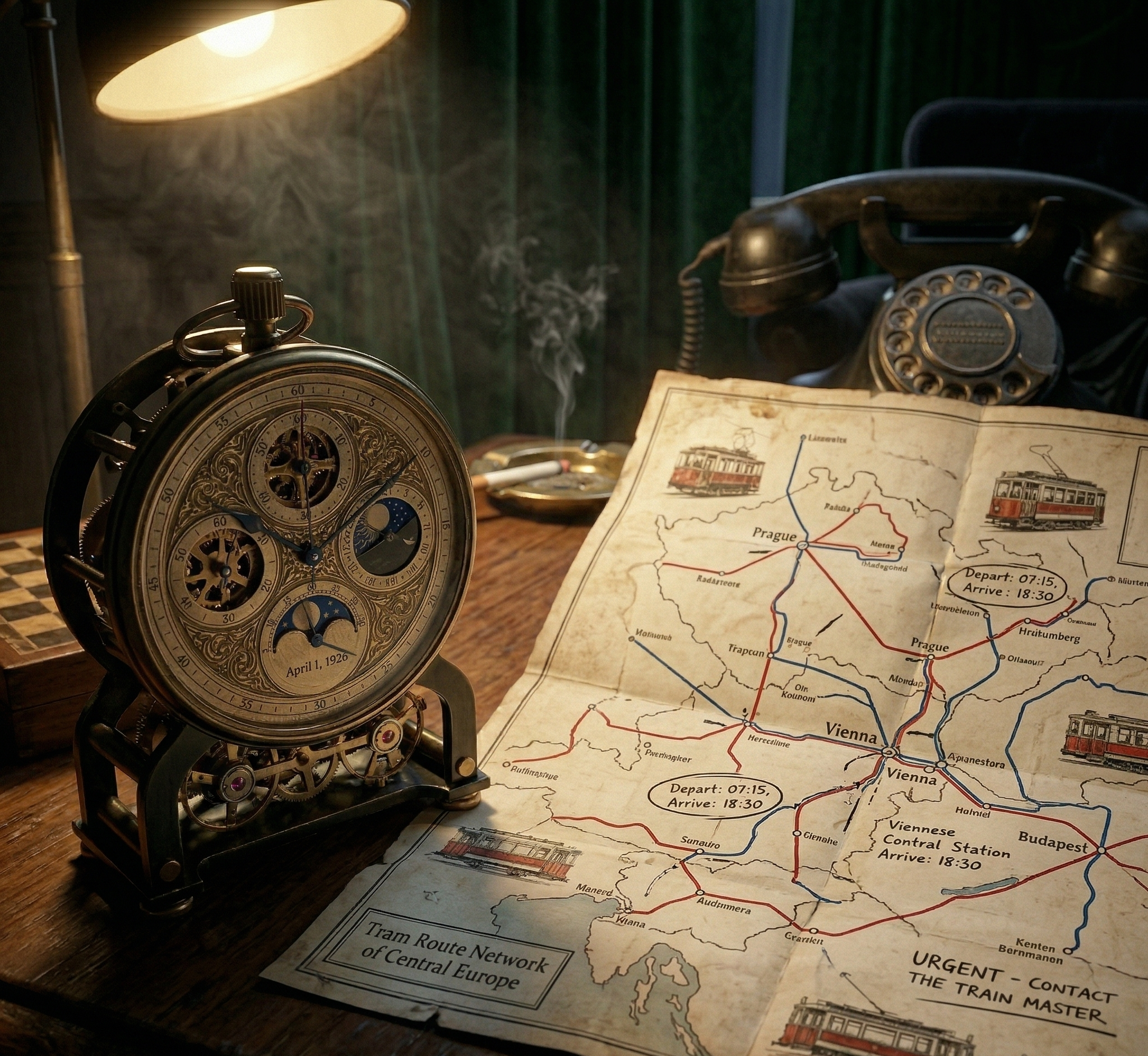
Yet, the prosecution’s theory immediately collided with a timeline so incredibly tight that it bordered on the supernatural. The case against Wallace hinged on a fatally narrow window of opportunity. On the evening of the murder, a 14-year-old milk boy named Alan Close delivered milk to the Wallace home. Close testified that Julia answered the door, took the jug from him and told him to hurry home out of the cold at approximately 6:37 PM. Meanwhile, Wallace was definitively sighted waiting for a tram a third of a mile away and boarded the vehicle by 7:06 PM. To make that specific tram connection, Wallace would have had to leave his house between 6. This scenario left Wallace with an exceptionally brief window of less than fifteen minutes—possibly as few as four to six—to commit the crime. Within this limited timeframe, the ailing 52-year-old, who had only one functioning kidney and suffered from chronic lung issues, would have needed to bludgeon his wife with eleven forceful blows, stage a burglary by ransacking the spare bedroom, meticulously cleanse himself of arterial blood spatter, change clothes, and proceed to the tram stop without appearing breathless or dishevelled to the conductors. the conductors.
When Liverpool CID sought to determine the physical plausibility of this scenario, they conducted a series of timing experiments. Even fit, young detectives, simulating the hypothetical sequence of the crime and the route to the tram, struggled to complete the tasks within fifteen to twenty minutes. Additionally, forensic analysis revealed no blood on Wallace's suit, and the home's drains and towels were entirely dry, providing no evidence of a hurried clean-up.
This perplexing convergence of timing and physical evidence has contributed to the case's enduring reputation. Renowned crime novelist Raymond Chandler described it as the "impossible murder because Wallace couldn't have done it, and neither could anyone else. Similarly, Dorothy L. Sayers observed that the case was unique in that every piece of evidence "pointed equally convincingly in both directions."
If Wallace was guilty, he accomplished a superhuman feat of violence and forensic sterilisation that contradicted his own physical limitations. Conversely, if he was innocent, the crime required a perpetrator with intimate knowledge of his home and chess schedule, who exploited the prank phone call, murdered Julia, and disappeared into the foggy Liverpool night without leaving a trace—all within a matter of minutes.

Trial, Death Sentence, and a Legal Shock
On 22 April 1931, William Herbert Wallace stood trial for his life at the Liverpool Assizes. From the outset, the prosecution’s case, led by Edward George Hemmerde, relied entirely upon circumstantial evidence and an impossibly tight timeline. The defence, led by Roland Oliver, countered that the mysterious "Qualtrough" was likely a thief who had lured Wallace away to steal his insurance takings. However, what arguably harmed Wallace the most in the court was not forensic proof, but his own baffling demeanour. A devoted practitioner of Stoicism, Wallace maintained a rigid, almost unnatural composure throughout the proceedings, attributing his lack of outward emotion to disciplined fortitude. To the jury and the gallery, however, this emotional detachment appeared indistinguishable from the cold callousness of a calculating killer.
The presiding judge, Mr Justice Wright, recognised the perilous thinness of the Crown's case. In his summing-up, the judge inclined heavily toward an acquittal, famously noting that the murder was "almost unexampled in annals of crime". He cautioned that the evidence could not safely support a final inference of guilt, later remarking that while Wallace's alibi might have seemed "too good to be true," that was not a sufficient argument upon which to hang a man. Despite this clear judicial guidance, the local jury—likely swayed by hostile press coverage and police briefings—deliberated for little more than an hour before returning a devastating verdict: guilty. Wallace was sentenced to death by hanging and transferred to the condemned cell at Walton Gaol.
Yet, the tragedy had not yet ended. In a notable display of solidarity, the Prudential Staff Union held its own secret mock trial in London, unanimously concluded that Wallace was innocent, and agreed to fully fund his costly legal defence. Armed with this crucial financial backing, Wallace's defence team took his case to the Court of Criminal Appeal in London in May 1931.
What happened next transformed the Wallace mystery from a mere true-crime puzzle into a monumental legal landmark. Historically, the Court of Criminal Appeal overturned verdicts only for procedural errors, newly discovered evidence, or bad instructions from the presiding judge. However, in an unprecedented ruling, the appellate court unanimously quashed the jury's verdict, finding that it "cannot be supported, having regard to the evidence". This dramatic reversal marked the first time in British legal history that an appeal was granted after a re-examination of the same evidence presented at trial. The appellate court effectively declared the jury’s decision legally and factually perverse, setting a groundbreaking precedent.
Wallace walked out of the court a free man, but the shadow of the gallows followed him. Though the appellate judges had saved his life and redefined British jurisprudence, he returned to a community that still widely believed he had gotten away with the perfect crime.

Theories, Suspects, and the Man in the Shadows
The enduring intrigue of the Julia Wallace case stems from its status as an apparently unsolvable puzzle, with each piece of evidence supporting contradictory interpretations. Both experts and amateur investigators have debated three principal theories, yet none has conclusively resolved the uncertainties surrounding the events of that night.
The first and most immediate theory posits that William Herbert Wallace was a cold-blooded killer. The prosecution argued that Wallace placed the "Qualtrough" call himself, using a disguised voice to establish an alibi. Upon returning from work, he allegedly stripped naked or used his mackintosh as a shield, bludgeoned Julia to death, meticulously cleaned away the blood, staged a burglary, and calmly caught his tram. However, this theory is significantly undermined by Wallace’s frail physical condition and the extremely limited timeframe. A chronically ill 52-year-old man, suffering from kidney disease and lung issues, would have had less than fifteen minutes to execute a frenzied attack, completely cleanse himself, and walk to a tram stop without appearing breathless or distressed to the conductors. Furthermore, forensic experts found no blood on Wallace or in the home's drains.
The second theory implicates an unknown outsider—a burglar who lured Wallace away to steal his insurance collections. Tuesday was the day before Wallace deposited his takings with the Prudential Assurance Company, so the cash box would have contained the largest sum. However, the burglary theory contains significant inconsistencies. Only four pounds were taken from the forced-open box, which was then neatly returned to its shelf. The intruder ignored five pounds in an upstairs jar and the money in Julia's handbag. Critics question why a typical thief would devise such an elaborate and risky chess-club phone call when a simple forged note would have sufficed.
The third and most compelling alternative theory focuses on Richard Gordon Parry, a 22-year-old former colleague of Wallace. Parry, known locally for his extravagant lifestyle, had previously been caught by Wallace stealing from Prudential clients. He was familiar with Wallace's routine, chess schedule, and the Wolverton Street residence. Notably, a garage mechanic named John Parkes later reported that Parry brought his car in for a thorough cleaning on the night of the murder, during which Parkes claimed to have discovered a blood-soaked glove in the glove compartment. However, Parry does not provide a definitive solution to the case. Police records indicate he had a seemingly ironclad alibi for the time of the murder, corroborated by Olivia Brine, who stated he was at her house from 5:30 PM to 8:30 PM.
Crime novelist P.D. James proposed a "synthesis" theory, suggesting that Parry made the call as a malicious prank, and Wallace subsequently used it as an alibi to murder his wife. However, this theory also fails to account for the complete absence of forensic evidence implicating Wallace. Ultimately, the truth remains obscured by a network of false leads, leaving the identity of Julia's killer unresolved.
Why the Case Never Dies
Nearly a century later, the murder of Julia Wallace remains a quintessential example of the British whodunit. Its enduring fascination derives from its resemblance to the plot structures of Golden Age detective fiction. As Dorothy L. Sayers observed, the case offers "an unrivalled field for speculation" because each piece of evidence can be interpreted in entirely contradictory ways. The narrative is anchored by the unusual telephone call from "R. M. Qualtrough," a mysterious figure who directed Wallace to a nonexistent address. This elaborate deception compels investigators to consider two possibilities: that Wallace orchestrated an intricate alibi or that he was an innocent party ensnared by a sophisticated scheme.
Then, there is the sheer physical impossibility of the timeline. The painfully narrow window of opportunity—bordered by the milk boy's delivery and Wallace's confirmed tram departure—left the killer with a margin of mere minutes. Executing a frenzied bludgeoning, flawlessly disposing of the weapon, scrubbing away all traces of the massive blood spatter, and calmly catching a tram defies human capability, particularly for a chronically ill 52-year-old man. Edgar Lustgarten aptly described the mystery as a "chess problem that ends in perpetual check." At the same time, Raymond Chandler immortalised it as the "impossible murder because Wallace could.”
Finally, the legend of the case is anchored by the tragic dichotomy between Wallace's legal exoneration and the continuing public suspicion that ultimately destroyed his life. Although the Court of Criminal Appeal made legal history by overturning his conviction because it was not supported by the strength of the evidence, the people of Liverpool remained convinced he had gotten away with the perfect crime. Wallace returned to a world where he was shunned by former customers, subjected to hate mail, and isolated in a desk job. He died of kidney disease less than two years later, a legally innocent man who the court of public opinion nonetheless condemned. Today, the Wallace case remains officially unsolved, a tantalising masterpiece of ambiguity that continues to”
The Truth That Wouldn’t Stay Still
Decades later, the spectre of Julia Wallace continues to haunt the blood-stained parlour of 29 Wolverton Street. The most unsettling aspect of this case is that Julia Wallace's killer was never conclusively identified, and the crime remains officially unsolved. Every armchair detective, legal scholar, and true-crime historian who examines this 1931 Merseyside tragedy ultimately encounters the same obstacle: the truth consistently eludes definitive proof.
As true-crime writer Edgar Lustgarten observed, this case is a maddening enigma—a "chess problem [that] ends in perpetual check," where any set of circumstances supports two entirely incompatible hypotheses. It represents the ultimate locked-room mystery, with each piece of evidence counterbalanced by another. If William Wallace was guilty, he accomplished a physically impossible feat of forensic sterilisation. If Richard Gordon Parry was the perpetrator, he secured an ironclad alibi and evaded a comprehensive police investigation. The evidence points equally in all directions, resulting in a persistent legal and historical stalemate.
However, the true horror of the Wallace case lies not only in its structural paradoxes or the mysterious telephone call, but in the sheer savagery of the act itself. Unimaginable terror marked Julia's final moments. Whether she opened her door to a trusted acquaintance, a desperate thief, or her husband of eighteen years, she was confronted with a frenzied and merciless attack. Her skull was shattered by multiple brutal blows from an unidentified weapon, leaving her body amidst a horrific tableau of blood, brain tissue, and bone. The notion that an individual could inflict such violence, cleanse themselves of all evidence, and disappear without a trace is profoundly disturbing. Night may never be fully understood. The passage of time has obscured crucial evidence, including the origins of the Qualtrough call, the location of the murder weapon, and the fate of the blood-stained mackintosh. Only Raymond Chandler's enduring assessment remains: it is "the impossible murder because Wallace couldn't have done it, and neither could anyone else." Julia Wallace's story does not provide a conventional detective-fiction resolution, instead leaving a persistent sense of uncertainty regarding the perpetrator's identity and motives.
References
Bury, L. (2013, October 28). PD James claims to have solved 1931 cold case murder. The Guardian.
Crampton, C. (2020, September 30). The telephone call transcript. Shedunnit.
Kent State University Libraries. (n.d.). The killing of Julia Wallace. Special Collections and Archives.
Qualtrough, R. M. (2020, January 22). Crime scene & relevant locations. The Julia Wallace Murder Foundation.
Russell, M. (2021). Checkmate: The Wallace murder mystery.
Russell, M. (n.d.). Julia Wallace murder. Liverpool City Police.
Stewart, V. (2013, November 5). A solution to the 'perfect murder'? P. D. James and the case of Julia Wallace. School of English Blog, University of Leicester.
The Kent State University Press. (2017). The killing of Julia Wallace.
The Post. (2023, March 12). Chess, prank calls and murder: Who really killed Julia Wallace? The Post.
The story of the 1930s "impossible murder" that utterly fascinated Raymond Chandler. (n.d.).Gizmodo.
The structural and forensic anomalies of the Julia Wallace homicide: A comprehensive re-evaluation of Britain’s most enigmatic cold case. (n.d.).
Winter, E. (2008). Edward Winter presents: Unsolved chess mysteries (24). ChessBase.
Winter, E. (2025). Chess and the Wallace murder case. Chess Notes.