The Shadow of 1945: World War || Still Shapes Global Politics
The Conflict That Concluded a Historical Epoch and Quietly Laid the Foundations for the Modern World
World War II did not merely conclude with the surrender of armies in 1945; it signified the collapse of a centuries-old global order. Although the conflict may appear remote today, its consequences remain profound. The war introduced instability, ideological rivalry, and the termination of imperial dominance. In its aftermath, a new power structure emerged, defined by industrial capacity, strategic alliances, and competing ideologies. The dissolution of empires and ensuing revolutions fundamentally transformed the global landscape.
The war compelled nations to confront the profound consequences of technological and political transformation. It introduced weapons of mass destruction, which served both as instruments of threat and deterrence. These weapons inflicted psychological and physical harm, shifting the nature of the conflict toward ideological and perceptual domains. Modern global governance arose from the recognition of the old order's fragility, as revealed by the devastation of the war.
The impact of World War II remains evident in contemporary international relations. The alliances, borders, and narratives established during and after the conflict continue to influence state behaviour, policy formation, and national identity. Many nations reference the war when making significant decisions or articulating their self-conceptions. While the war concluded one historical era, it simultaneously established the foundation for the current global system, which continues to be shaped by the events of 1945.
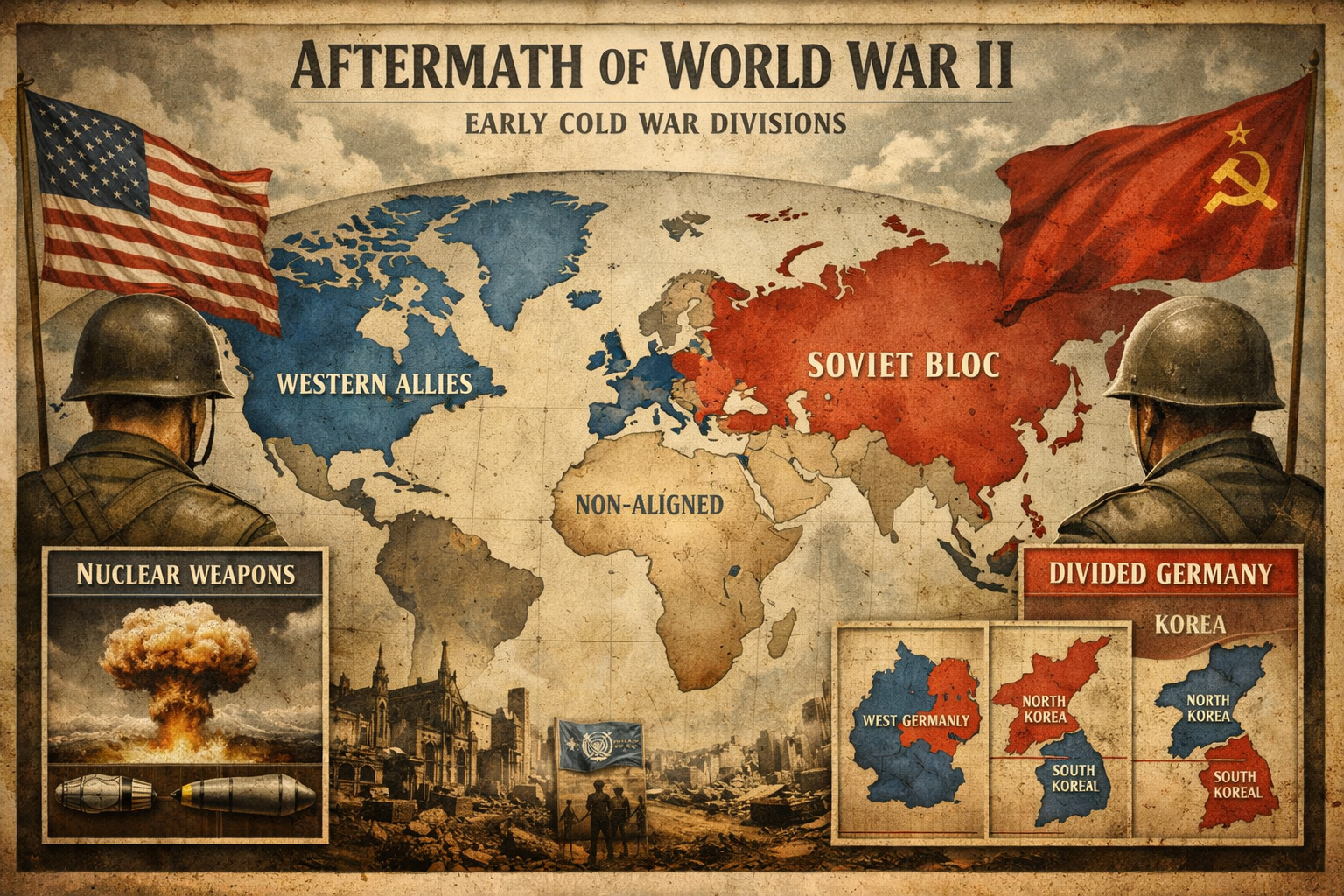
The End of the Old World (1945)
The year 1945 marked a pivotal turning point in global history. Most notably, it signalled the end of European imperialism, a force that had previously appeared both permanent and inevitable. The traditional system of competing European great powers, which had dominated international relations since 1815, was decisively dismantled. The conflict demonstrated that nations such as Britain and France no longer possessed the military or economic strength to maintain their extensive colonial empires, thereby initiating a wave of decolonisation. Europe, once the centre of global affairs, was relegated to a secondary role and became subject to the policies of external powers.
In the aftermath of the war, Europe experienced widespread devastation and hardship. Contemporary photographs and films depict crowds traversing ruined cities and desolate landscapes. Orphaned children and exhausted women sifted through debris, while deportees and concentration camp survivors, visibly emaciated and ill, confronted the camera. Public transportation, operating infrequently over damaged infrastructure, further illustrated the conflict's pervasive impact. With the exception of the Allied forces, the continent's population and resources were left depleted.
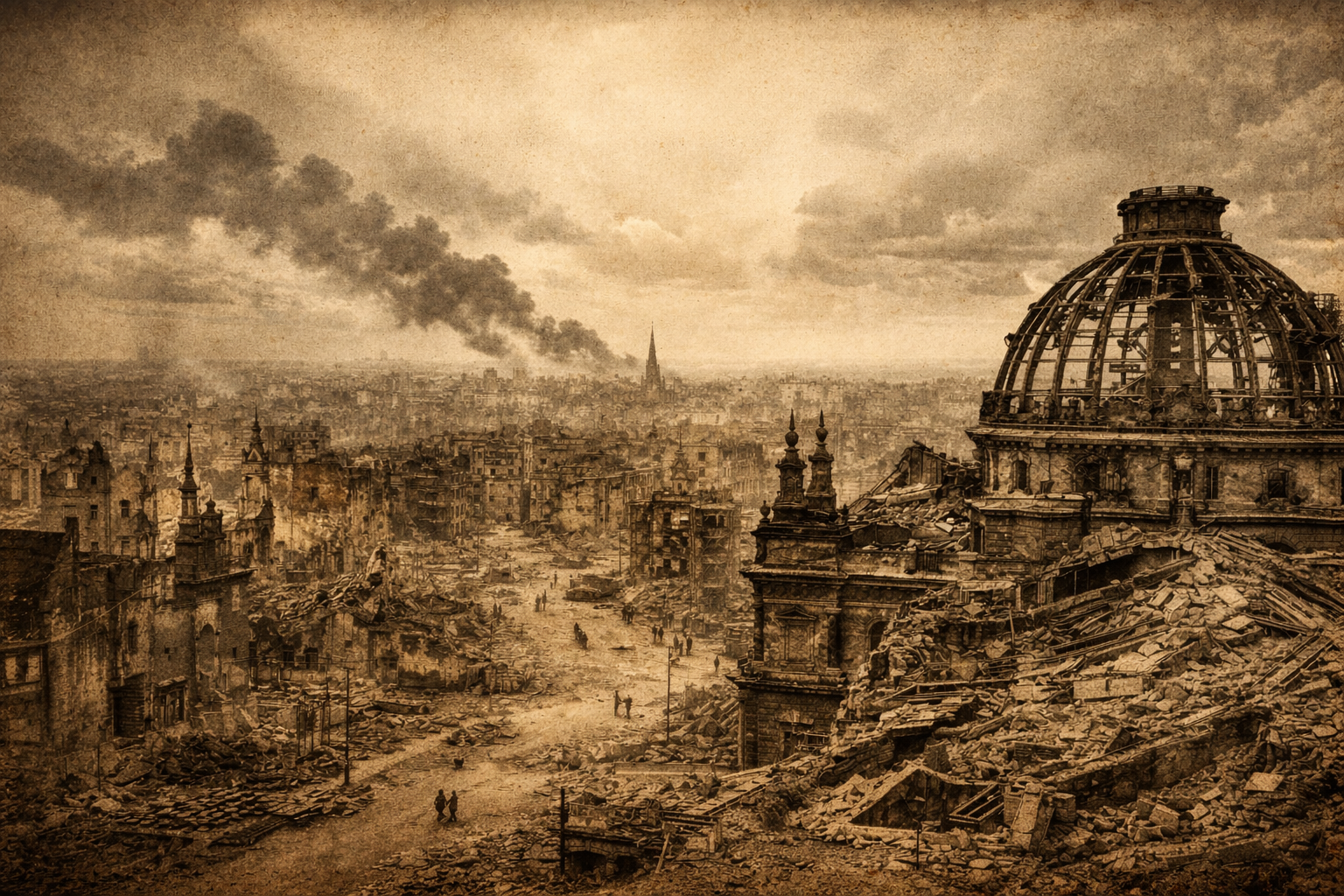
At the heart of this global transformation was the utter devastation of the Axis powers. Germany, whose aggressive expansionism triggered the core of this global transformation, suffered devastation. Germany, whose expansionism initiated the conflict, was militarily defeated, economically devastated, and divided into occupation zones, losing its national sovereignty. Allied bombing campaigns destroyed much of its urban infrastructure; for example, 75 per cent of Berlin's buildings became uninhabitable, and cities such as Hamburg and Dresden were similarly devastated. Millions of ethnic Germans were forcibly expelled from Eastern Europe in a wave of displacement. Japan faced comparable destruction, culminating in the atomic bombings of Hiroshima and Nagasaki by the United States, which forced Japan's surrender and fundamentally altered the nature of warfare. France was severely enfeebled. France's standing as a Great Power was permanently fractured by its swift military collapse in 1940 and the subsequent humiliating German occupation, dealing an enormous blow to its national pride. Meanwhile, Great Britain had exhausted its wealth to defeat Germany; the conflict essentially bankrupted the nation, resulting in over £3,000 million in overseas debt and forcing a deep financial dependence on the United States. Stripped of their economic independence, both nations endeavoured to retain their global influence.
The devastation of Europe created a power vacuum that was filled by two superpowers: the United States and the Soviet Union. The United States emerged unscathed and economically dominant, possessing half of global manufacturing capacity and the atomic bomb. Despite suffering immense losses, the Soviet Union established a formidable military presence and occupied Eastern Europe. These two rivals, representing democratic capitalism and authoritarian communism respectively, assumed leadership in global affairs. The division of Europe by the Iron Curtain initiated the Cold War and entrenched new geopolitical divisions.
The Cold War, the division between East and West, and the ideological struggle between communism and capitalism did not arise from predetermined rules but rather from specific historical developments. Both the past and future of Europe were fundamentally altered. In retrospect, the period from 1945 to 1989 constituted an interregnum, shaped by the enduring consequences of prolonged conflict. The narrative of Europe's history was irrevocably transformed.
The Birth of the Cold War World
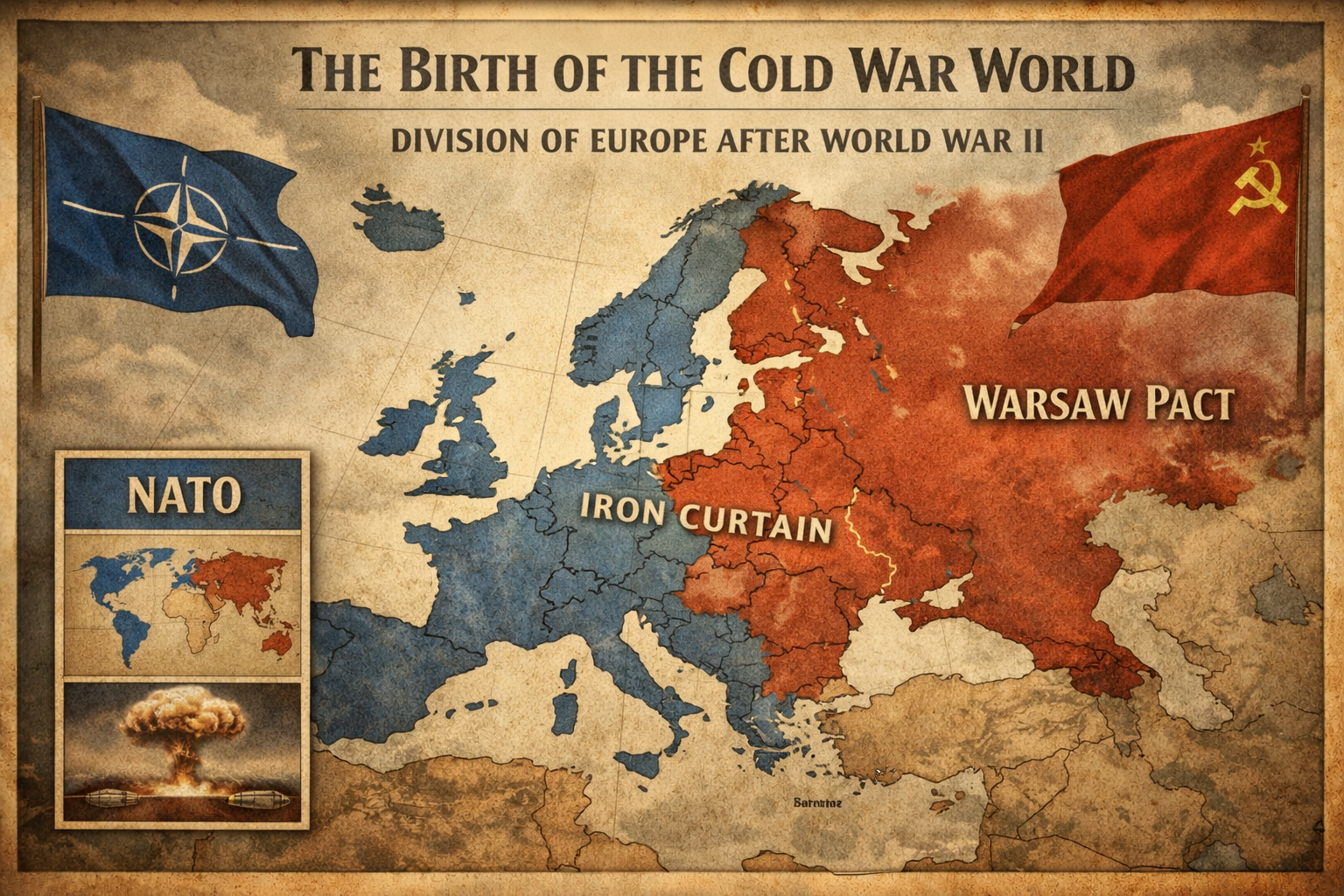
The conclusion of the Second World War left a power vacuum in Europe that was quickly filled by the United States and the Soviet Union, leading to the birth of a deeply polarised world. This new era, known as the Cold War, was defined by fundamental ideological differences between democratic capitalism and Soviet communism. The ideological clash, characterised by the Soviet pursuit of a centrally planned, state-controlled society versus the American advocacy of free markets, private enterprise, and constitutional democracy, split the globe into two hostile camps. As one American diplomat noted in 1947, there were now "two worlds instead of one," and the world was embarking on an existential struggle over how best to govern industrial societies. These two ideologically opposed superpowers set out to remake the international system in their own image.
Winston Churchill described the split of Europe in a March 1946 speech in Fulton, Missouri, saying an "iron curtain" had fallen from Stettin in the Baltic Sea to Trieste in the Adriatic Sea. To the east, the Soviet Union consolidated its control, installing communist governments in Poland, Hungary, Romania, and Bulgaria to protect itself against future threats from the West. This Iron Curtain blocked Eastern Europe from the rest of the world, marking the split between East and West with barbed wire, mines, and armed guards.
Germany was the epicentre of this conflict. After the war, the country and Berlin were split into four occupation zones: the US, Britain, France, and the Soviet Union. Tensions grew as the Western Allies merged their zones and introduced the Deutsche Mark in 1948. Angered by these actions and Western prosperity, Stalin blockaded West Berlin. The Western powers responded with a year-long airlift. This crisis killed hopes of a unified Germany. In 1949, the Western zones became the Federal Republic of Germany (West Germany); the Soviet zone became East Germany.
The Berlin crisis demonstrated to Western powers the necessity of collective defence. In April 1949, the United States, Canada, and ten European nations signed the North Atlantic Treaty Organisation (NATO) pact. This alliance guaranteed mutual military assistance in the event of an attack, marking a departure from the United States' previous policy of avoiding peacetime alliances and from its earlier stance of seeking to establish a robust defence against the Soviet Union.
The formal militarisation of the opposing bloc followed several years later. When West Germany was permitted to rearm and officially joined NATO as a sovereign state in May 1955, the Soviet Union responded immediately. Just days later, Moscow announced the Warsaw Pact, a mutual defence alliance that brought together the Soviet Union and its Eastern European satellite states, including East Germany, Poland, Czechoslovakia, Hungary, Romania, Bulgaria, and Albania, under a unified military command. With the establishment of these two heavily armed alliances, the Cold War was firmly set in stone, cementing a divided Europe that would characterise global geopolitics for the next four decades.
Nuclear Weapons and the New Logic of Power
On August 6 and 9, 1945, the United States dropped atomic bombs on the Japanese cities of Hiroshima and Nagasaki, which ushered in a terrifying new era of warfare. The apocalyptic destruction demonstrated that a single weapon could now devastate an entire city, profoundly changing the traditional logic of military power. No longer was war simply a matter of battling on the front lines; the advent of atomic, and later thermonuclear, weapons meant that entire societies were immediately vulnerable to sudden annihilation. The sheer power of these devices, capable of blowing blinded and burned birds out of the sky during tests, served as a grim warning of the civilizational suicide they could inflict.
This unprecedented lethality forced a profound shift in international relations and strategic analysis. Historically, military strategy had focused on the use of force to achieve victory on the battlefield. However, in the nuclear age, the main objective of a military establishment shifted from winning wars to averting them. Because the costs of a nuclear conflict would be unimaginable, leaders realised that nuclear weapons were largely unusable for traditional military conquests. Instead, their value lay in their psychological impact, which gave rise to the concept of nuclear deterrence. Deterrence relied on the threat of devastating retaliation to dissuade an adversary from launching an attack. The battles of the Cold War were therefore fought on "psychological terrain" rather than through physical combat.
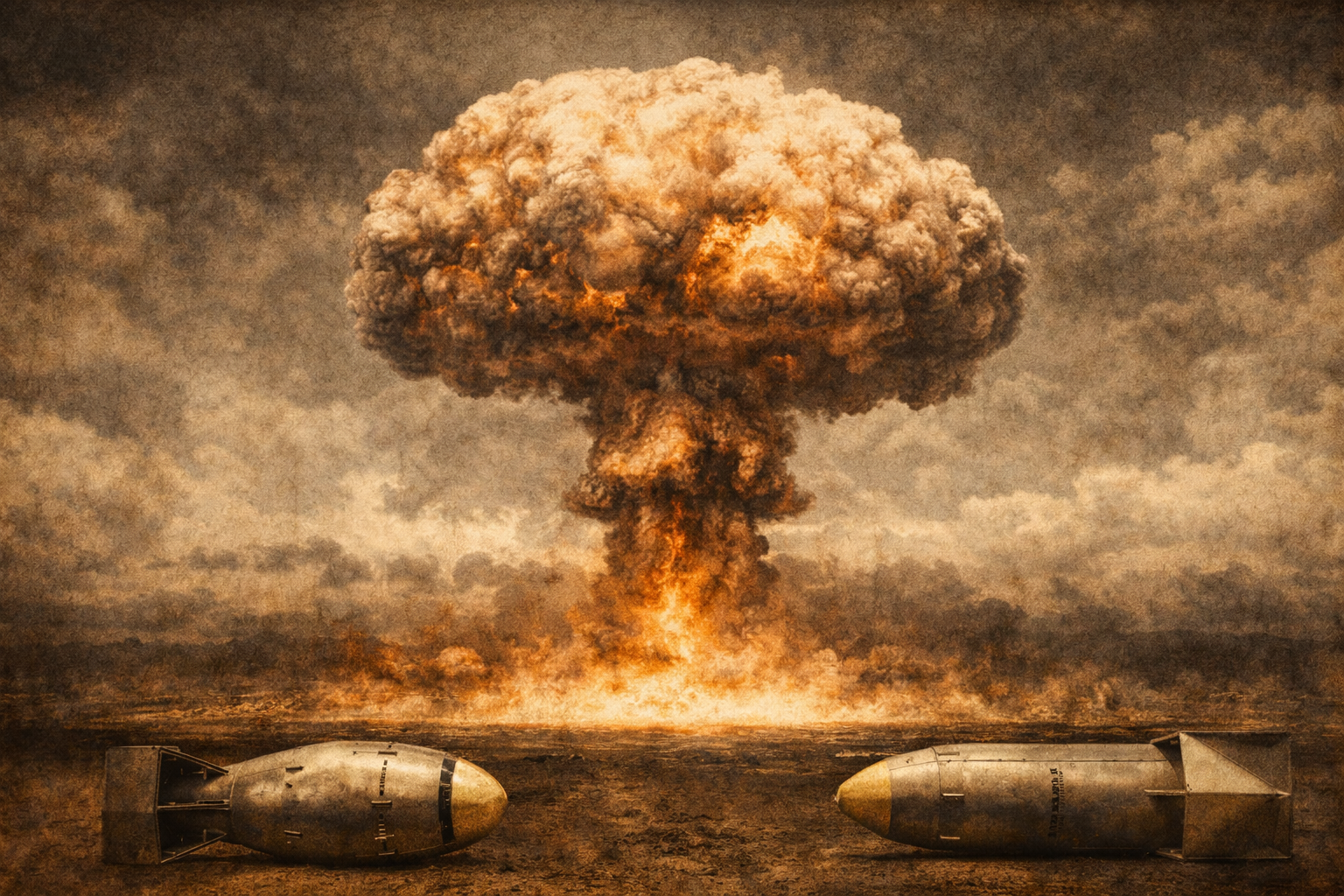
As the United States and the Soviet Union accelerated their arms race, the dynamic evolved into a paralysing nuclear stalemate. By the 1960s, the two superpowers had amassed vast arsenals, ensuring that even if one side launched a surprise first strike, the other would retain enough firepower to deliver a catastrophic retaliatory blow. This reality was formalised in the doctrine of Mutually Assured Destruction (MAD). Championed by leaders such as US Secretary of Defence Robert McNamara, MAD rested on the grim assumption that if neither side could escape destruction, no rational leader would initiate a conflict. Rather than attempting to erect futile defences to protect populations from nuclear fallout, MAD relied on "mutual assured vulnerability," a system in which both sides held each other's civilian populations as permanent hostages.
Consequently, permanent fear became a deliberate and vital strategic tool. British Prime Minister Winston Churchill famously observed that in this new era, peace had become the "sturdy child of terror". The dread of a global conflagration, often referred to as the "crystal ball effect", ensured that political leaders vividly understood the catastrophic consequences of war well in advance, inducing a strong caution previously absent in earlier eras. Strategic theorists like Thomas Schelling emphasised that nuclear strategy was now the "art of coercion, intimidation and deterrence," exploiting the potential for immense pain to manipulate an adversary's political choices.
The deliberate use of mutual fear, frequently through high-risk diplomatic strategies such as brinkmanship and calculated risk-taking, prevented direct military confrontation between the superpowers. Paradoxically, the same nuclear weapons that threatened human survival also contributed to global stability by substituting actual violence with the ongoing threat of catastrophic destruction.
The Collapse of Empires
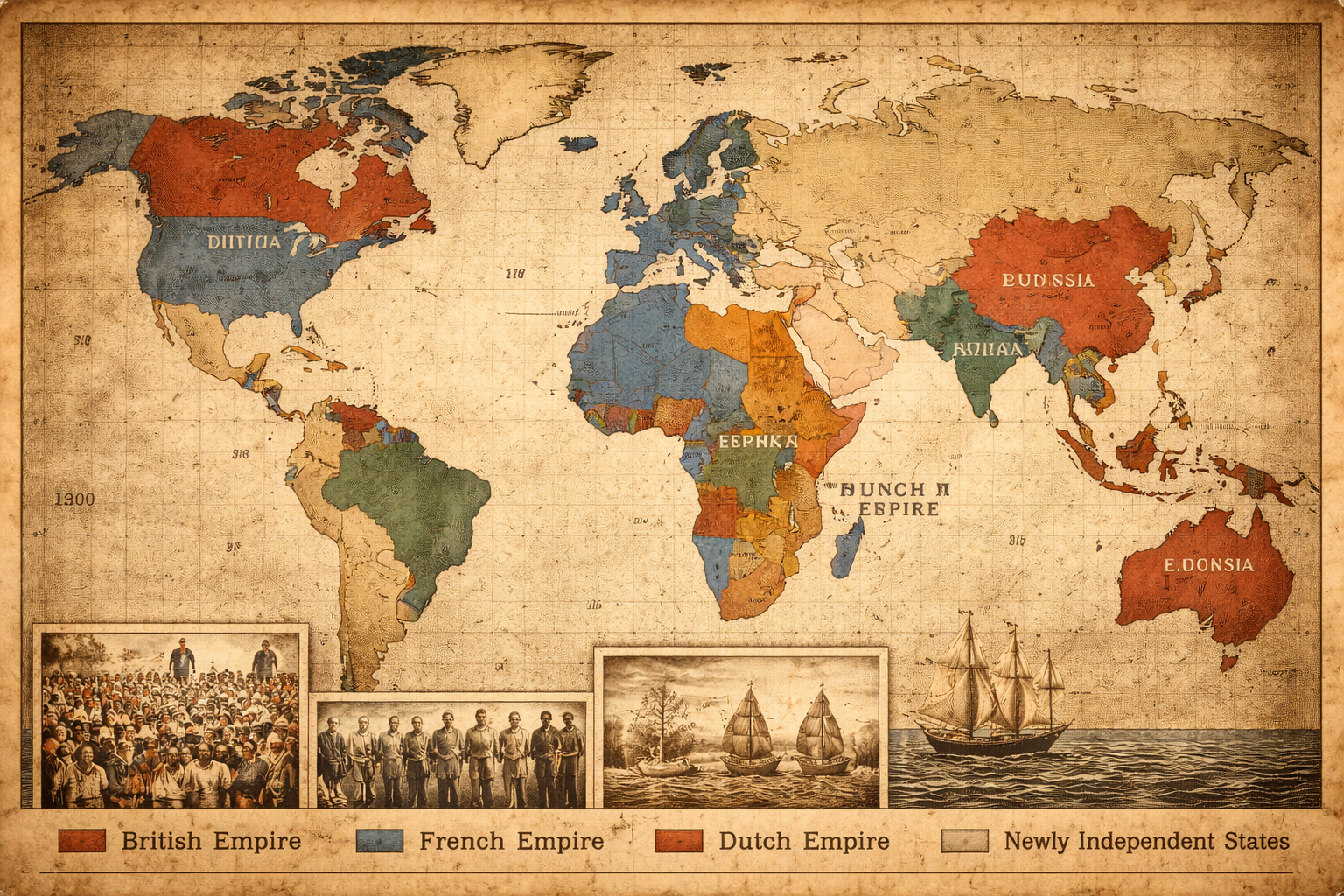
The conclusion of the Second World War triggered a seismic shift in global geopolitics, initiating the rapid collapse of the European overseas empires. As Britain and France struggled to maintain their global influence, territories in Asia, Africa, and the Middle East gradually moved toward new political arrangements. In several regions, the withdrawal of imperial control reshaped borders and political systems, creating dynamics that would influence regional politics for decades to come.
Before the war, European nations controlled large expanses of the globe, but the conflict radically changed the balance of power. Both Great Britain and France emerged from the war severely enfeebled, lacking the military and economic resources to sustain their far-flung imperial holdings indefinitely. Britain, despite its victory, was financially exhausted; it had incurred enormous overseas debts to fund the war effort and was deeply dependent on loans from the United States. France had suffered the deep humiliation of a swift military defeat and German occupation in 1940, fracturing its prestige.
Simultaneously, the myth of European invincibility was permanently shattered by Japan's rapid wartime conquests of British, French, and Dutch territories in Asia, which proved to colonised populations that European armies could be defeated by non-European forces. Furthermore, the rhetoric of the war itself fuelled anti-colonial movements; the 1941 Atlantic Charter’s promise of the right to self-determination, though intended by Winston Churchill to apply only to Nazi-occupied Europe, was eagerly adopted by nationalist leaders across the globe.
The unravelling of empires began in Asia. India, the "jewel in the crown" of the British Empire, was among the first to break free. The British Labour government recognised it could no longer contain the massive Indian nationalist movement. Unable to reconcile the competing demands, the British hastily withdrew in August 1947, partitioning the subcontinent into two independent states: India and Pakistan. This partition triggered catastrophic inter-communal violence and massive population displacement.
In the Dutch East Indies, the nationalist leader, Ahmed Sukarno, utilised the vacuum left by the Japanese surrender to declare an independent Republic of Indonesia in August 1945. The Netherlands, desperate to retain the colony’s wealth to rebuild its own ruined economy, deployed troops to crush the rebellion. A bitter four-year guerrilla war ensued, which only ended when the United States, fearing the conflict would drive Indonesian nationalists toward communism, threatened to suspend Marshall Aid to the Netherlands. The Dutch officially conceded independence in December 1949.
France’s violent struggle to retain its empire was motivated by a desperate desire to restore its tarnished status as a great power. In French Indochina, the communist and nationalist leader Ho Chi Minh declared Vietnam's independence in September 1945. The French refused to accept this, launching an eight-year gruelling war of reconquest. Despite massive financial backing from the United States, French forces were unable to overcome the Vietminh guerrilla tactics. The humiliating French surrender at Dien Bien Phu in May 1954 decisively ended French rule in Indochina, leading to the Geneva Agreements that partitioned Vietnam and granted independence to Laos and Cambodia.
The momentum of decolonisation soon swept across the African continent. In 1957, the Gold Coast became the first sub-Saharan colony to achieve independence, taking the name Ghana under the leadership of Kwame Nkrumah. By 1960, British Prime Minister Harold Macmillan formally acknowledged the "wind of change" blowing through Africa, signalling a wider British retreat. That same year, France granted independence to a host of its sub-Saharan colonies, realising the political and financial unsustainability of maintaining direct rule.
However, the transition was exceptionally violent in colonies with large white settler populations. In Kenya, the British deployed 100,000 troops to brutally suppress the Mau uprising throughout the 1950s before finally conceding independence in 1963. Meanwhile, France fought a savage, eight-year war against the National Liberation Front (FLN) in Algeria. The Algerian War proved so traumatic that it nearly caused a civil war in France itself, toppling the Fourth Republic before President Charles de Gaulle finally negotiated Algerian independence in 1962.
Ultimately, the devastating cost of the Second World War combined with the unstoppable rise of local nationalisms transformed the globe, dismantling centuries-old European empires and replacing them with a new world of independent nation-states.
Borders and Conflicts Born from the War
The defeat of the Axis powers in 1945 did not bring a harmonious peace; instead, it laid the geopolitical groundwork for decades of global tension. The hasty agreements forged by the Allied powers at wartime conferences such as Yalta and Potsdam, combined with the physical locations of advancing armies at the war's end, created arbitrary boundaries that quickly hardened into the perilous front lines of the Cold War. Rather than resolving historical grievances, the settlement structures of the Second World War gave rise to new, militarised borders and persistent geopolitical conflicts.
The most prominent consequence of the Allied victory was the division of Germany. Following its unconditional surrender, Germany and its capital, Berlin, were divided into four occupation zones administered by the United States, Great Britain, France, and the Soviet Union. What was originally intended to be a temporary administrative arrangement to oversee demilitarisation and reparations soon fractured along ideological lines. As Western powers moved to unify their zones and rebuild the German economy, the Soviet Union retaliated with the 1948 Berlin Blockade. By 1949, this breakdown in cooperation led to the creation of two separate, heavily armed states: the capitalist Federal Republic of Germany (West Germany) and the communist German Democratic Republic (East Germany).
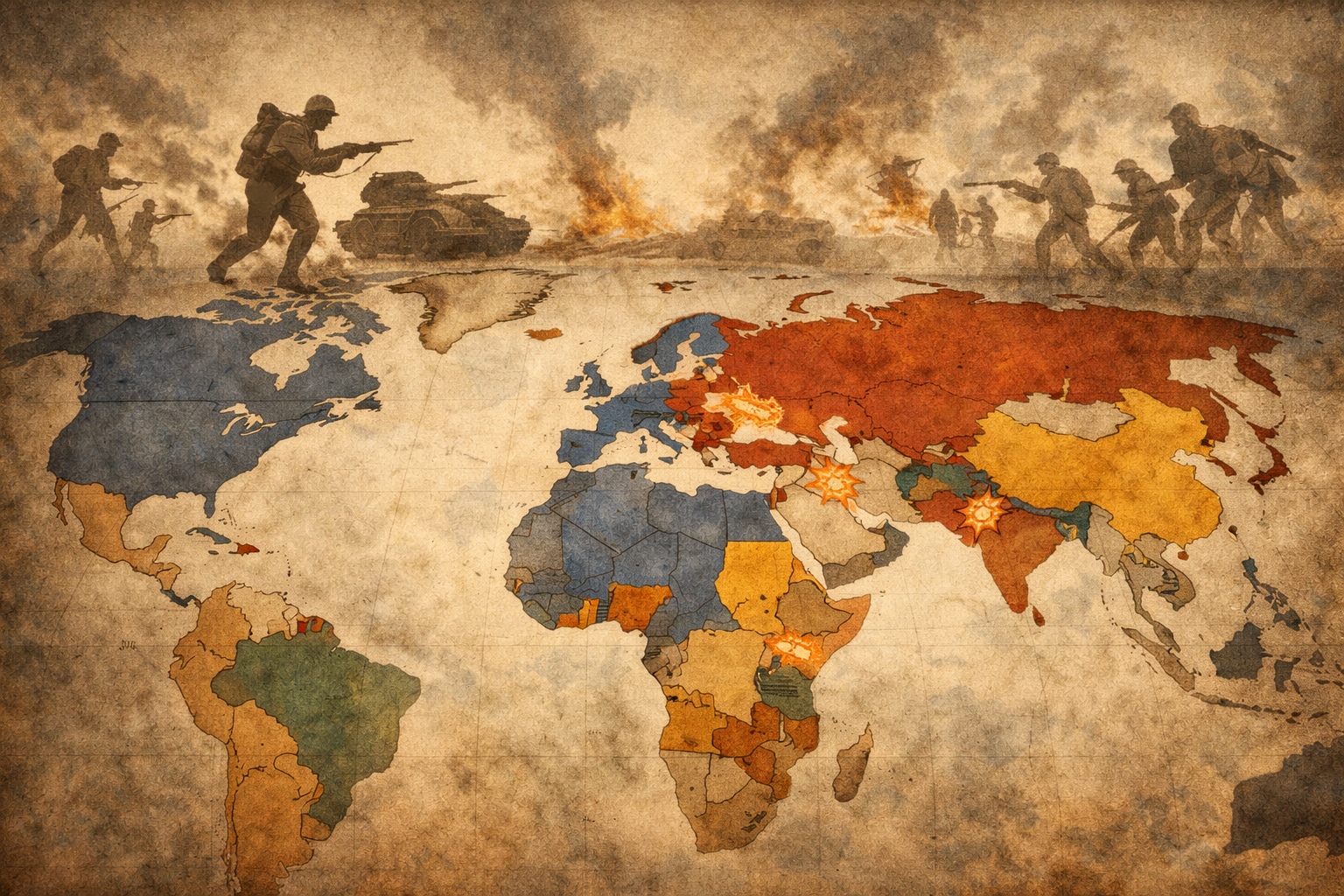
This physical partition extended across the continent. Prompted by a desire to create a security "buffer zone" against future invasions, Joseph Stalin used the Red Army's occupation of Eastern Europe to enforce a Soviet sphere of influence. The postwar settlements drastically redrew the map: the Soviet Union annexed the Baltic states and shifted Poland's borders hundreds of miles westward, compensating the Poles with former German territory. Behind what became known as the Iron Curtain, subservient communist regimes were installed, cutting off Eastern Europe from the West and subjecting its populations to decades of authoritarian rule.
The phenomenon of arbitrary wartime settlements sparking conflict was equally devastating in Asia. Korea, which had been under Japanese colonial rule since 1910, was hurriedly partitioned by the United States and the Soviet Union along the 38th parallel to facilitate the Japanese surrender. Because the superpowers could not agree on a unified administration, this temporary line consolidated into two mutually hostile states in 1948: the communist Democratic People's Republic of Korea in the North, and the American-backed Republic of Korea in the South. In 1950, North Korea invaded the South, triggering a brutal three-year proxy war that killed millions and ultimately ended in a stalemate, leaving the peninsula permanently and violently divided.
Furthermore, the power vacuum left by Japan's defeat immediately reignited unresolved internal conflicts. In China, the end of World War II meant the resumption of a bitter civil war between Mao Zedong's Communists and Chiang Kai-shek's Nationalists. When the Communists emerged victorious in 1949 and established the People's Republic of China, the defeated Nationalist government fled to Taiwan. Shielded by the United States Navy, Taiwan became a heavily armed capitalist bastion off the communist mainland. This resulted in enduring Cold War tensions, including the perilous offshore island crises of the 1950s, creating a volatile geopolitical standoff that persists to this day.
Ultimately, the peace of 1945 was an illusion. The settlement structures meant to liquidate the Second World War instead transformed temporary military demarcations into permanent borders, locking the globe into a new era of ideological confrontation and proxy wars.
The Institutions That Govern the New World
The global governance structure that shapes the modern world was purposefully designed in 1944 and 1945. Seeking to prevent a return to the catastrophic interwar years characterised by economic depression, destructive protectionism, and the failure of the League of Nations, the victorious Allied powers constructed a new international order resting on the twin pillars of collective security and world economic stability.
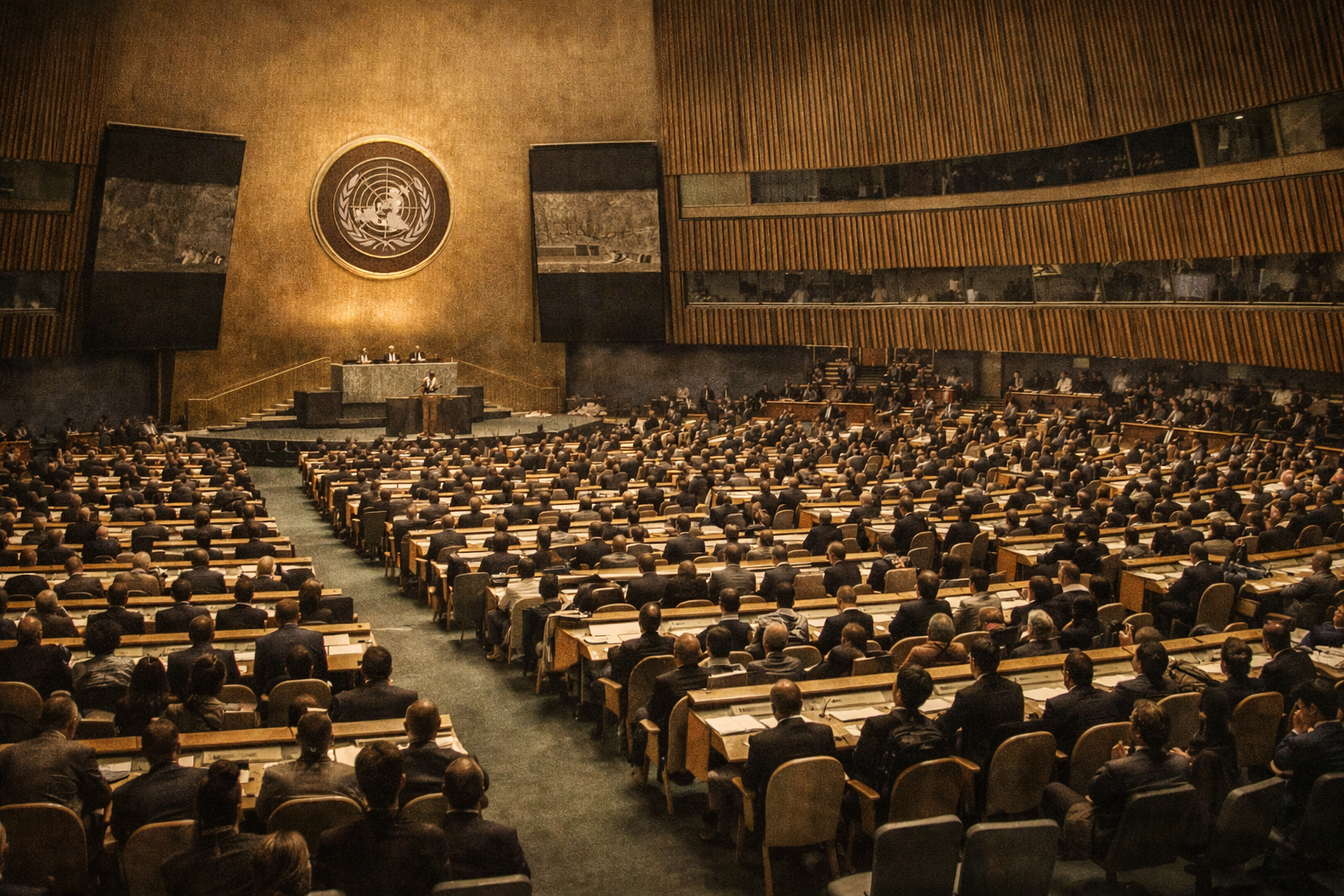
To secure the political peace, the United Nations (UN) was officially established in October 1945 following a conference of forty-six nations in San Francisco. Designed to replace the ineffective League of Nations, the UN strived to preserve world peace, promote social and economic progress, and safeguard universal human rights. To ensure it possessed the enforcement capabilities its predecessor lacked, the UN's architects created the Security Council. Within this body, the five major victorious powers, like the United States, Great Britain, France, China, and the Soviet Union, were granted permanent seats and the power of veto. While the emerging Cold War would frequently paralyse the Security Council's decision-making, the UN profoundly changed international relations by creating a permanent global assembly, and its specialised agencies would go on to achieve monumental successes, for example, the World Health Organisation's global eradication of smallpox.
In parallel with this political framework, the economic architecture of the modern world was forged at the Bretton Woods conference in New Hampshire in July 1944. Led by figures like the British economist John Maynard Keynes, the delegates sought to avoid the deflationary rigidity of the old gold standard and the chaotic currency fluctuations that had exacerbated the Great Depression. The resulting Bretton Woods system established an international regime of fixed exchange rates pegged to a gold-convertible US dollar.
To administer and enforce this new global economic system, the conference established two enduring financial institutions. The International Monetary Fund (IMF) was created to facilitate the balanced growth of international trade, stabilise exchange rates, and provide short-term loans to member countries facing imminent financial difficulties. Concurrently, the International Bank for Reconstruction and Development, universally known today as the World Bank, was established to provide funding for specific, long-term development projects and national infrastructure. This system was soon complemented by the General Agreement on Tariffs and Trade (GATT), which was signed in 1947 to progressively liberalise global commerce by reducing tariffs, and which eventually evolved into the modern World Trade Organisation (WTO).
Ultimately, the architects of this post-war settlement recognised that "a world in economic chaos would be forever a breeding ground for trouble and war". American President Franklin D. Roosevelt and his allies inextricably linked economic prosperity with joint security, hoping to remove the underlying material causes of future conflicts. While the system has evolved significantly over the decades to accommodate globalisation, floating exchange rates, and shifting geopolitical balances, the core institutions created at the end of the Second World War, and the UN, the IMF, and the World Bank, continue to serve as the bedrock of global governance today.
The Memory of War in National Politics
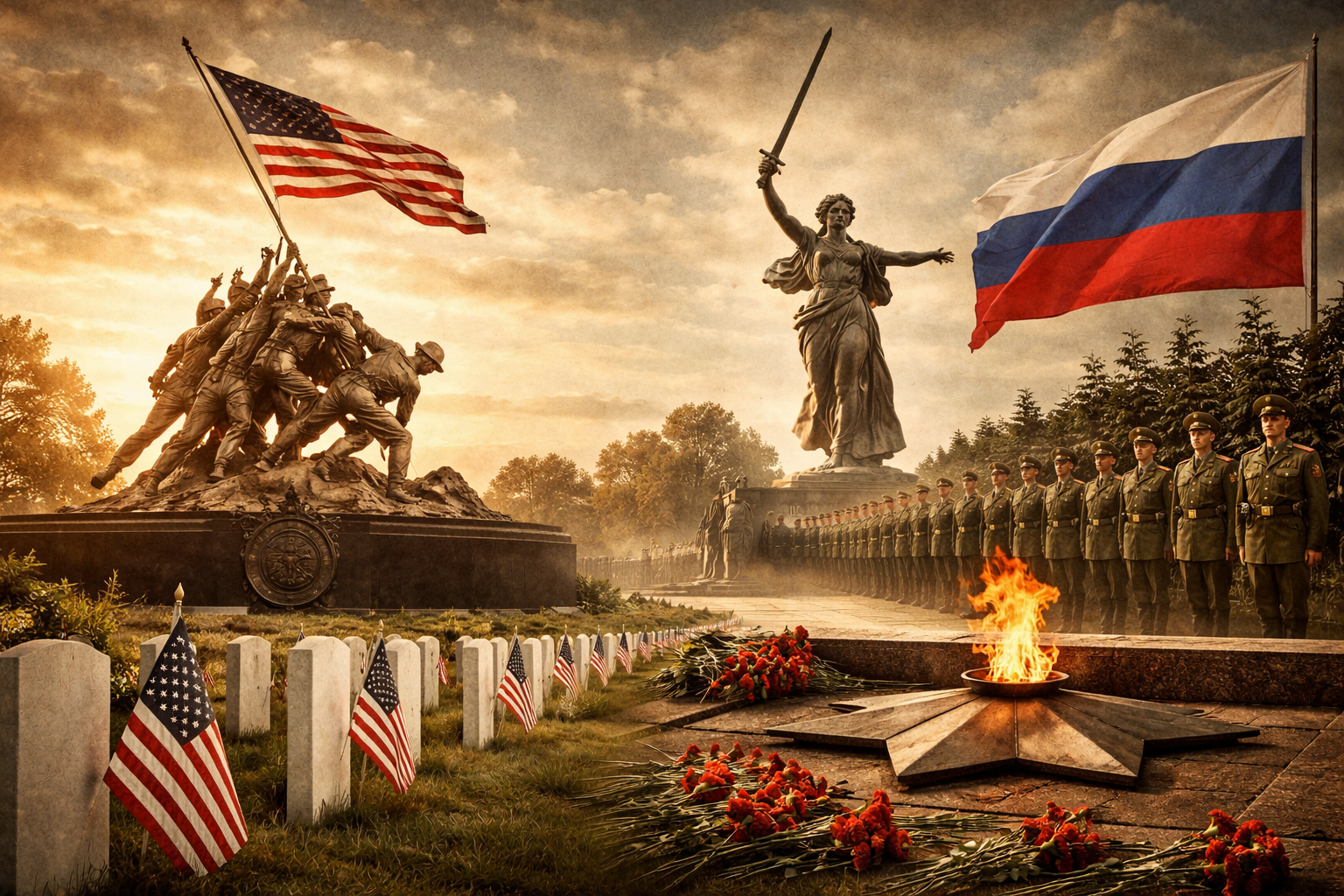
The memory of the Second World War continues to serve as a powerful political tool, shaping national identities and state narratives across the globe. Rather than a static historical record, the way different countries remember the conflict reflects their modern political needs, with national memories often curated to unite populations, justify state legitimacy, or navigate historical suffering.
In Germany, the memory of the war is profoundly defined through a sense of national guilt and historical responsibility. In the immediate postwar decades, many Germans engaged in a collective amnesia, preferring to focus on their own suffering in bombed-out cities and the hardships of reconstruction rather than the crimes of the Nazi regime. However, by the 1960s, a younger "sceptical generation" commenced to confront the older generation about the realities of the war and the extent of the nation's complicity. This agonising process of coming to terms with the past eventually transformed German national identity. Acknowledging the deep burden of its history and the catastrophic violence committed in the name of the German nation has served as the cornerstone of the modern Republic, ensuring that its political culture remains vigilant in taking responsibility for the past.
Conversely, in Russia, the conflict is remembered as the "Great Patriotic War," a narrative centred on heroic sacrifice and ultimate victory. The Soviet Union suffered unimaginable losses, with approximately 27 million citizens dead. To unite a devastated populace, the state heavily promoted a master narrative of national triumph over the invaders, which eventually eclipsed even the 1917 Revolution as the country's basic myth. This "cult" of the war has proven incredibly durable. Even after the collapse of the Soviet Union, post-Soviet leaders resurrected the victory narrative to foster national pride, consolidate statehood, and restore a sense of greatness and unity to the Russian nation.
Japan wrestles with a much more complex and internally contested memory of the conflict. The nation's collective memory is heavily influenced by the catastrophic end of the war, particularly the fire bombings of Tokyo and the atomic bombings of Hiroshima and Nagasaki. This unprecedented destruction created a strong national narrative of pacifism and victimhood, focusing heavily on the horrors of war. However, this intense focus on Japan's own suffering has often complicated its ability to completely reconcile with the memory of its aggressive imperial expansion and militarism across Asia. Consequently, Japanese national memory exists in a delicate tension between commemorating the trauma inflicted upon its own civilian population and managing the historical burden of its wartime conquests.
In China, the memory of the war is inextricably linked to an anti-imperial narrative and the triumph of national liberation. The conflict is remembered as a brutal struggle that caused immense civilian suffering, with millions of Chinese casualties and massive displacement. Politically, the war is framed as a critical turning point where the Chinese people, mobilised by patriotic resistance, successfully fought off foreign exploitation. This narrative not only highlights the defeat of Japanese imperialism but also functions as a crucial legitimising foundation for the modern Chinese state, symbolising the end of a long era of foreign humiliation and the triumphant rebirth of a strong, independent nation.
The War’s Shadow Today
The world we inhabit today still operates within a geopolitical system built in 1945. When the Second World War concluded, the victorious powers established a new international architecture created to prevent the recurrence of total war and manage a polarised globe. Rather than entering a wholly new epoch, contemporary international relations remain an extended epilogue to the settlements forged within the aftermath of that global conflagration.
The most visible legacy of this 1945 order is the lasting significance of the North Atlantic Treaty Organisation (NATO). Originally conceived in 1949 to keep the Soviet Union out, the Americans in, and the Germans down, the alliance has long outlived the ideological conflict it was built to fight. In the post-Cold War era, NATO's eastward expansion to include former Warsaw Pact nations—such as Poland, Hungary, and the Czech Republic—was viewed by Moscow as a serious breach of trust and a direct security threat. The contemporary tensions and military conflicts between Russia and Europe are firmly rooted in this historical dynamic, as Russia’s sense of weakness and its resentment over lost imperial buffer zones continually clash with the West's post-war security architecture.
This post-war blueprint extends far beyond Europe. In Asia, the security structures constructed in the immediate aftermath of the Second World War continue to dictate the regional balance of power. Fearing the spread of communism after 1945, the United States established a network of bilateral alliances and security guarantees encompassing Japan, South Korea, and Taiwan, while extending defence pacts to Australia and New Zealand. Today, as a multipolar world emerges and China's military and economic strength grows, the geopolitical stability of the Pacific Rim still relies entirely on these 1945-era alliance structures and the continuing presence of the American security umbrella.
Above all, the modern world remains trapped under the existential shadow of the atomic bomb, a weapon that radically changed the logic of power in 1945. The doctrine of nuclear deterrence and Mutually Assured Destruction—the grim realisation that any major conflict would result in mutual civilizational suicide—effectively froze the global status quo in place. The sheer destructiveness of these weapons transformed military strategy from the traditional pursuit of battlefield victory into the psychological art of coercion and intimidation.
Contemporary society remains in a paradoxical era shaped by the aftermath of 1945. The so-called "long peace" results not from inherent human harmony but from an artificial equilibrium sustained by the persistent threat of global destruction. The legacy of the mid-twentieth century continues to shape international borders, military strategies, and global institutions. Modern civilisation exists in a state of perpetual risk, reliant on nuclear deterrence for survival. Unless the paradigms of absolute power and mutual fear established after the Second World War are transcended, the world will remain under its enduring shadow. The continued dependence on deterrence demonstrates that the old world was not truly abolished; instead, it was reconstituted under the constant threat of annihilation.
References
Freedman, L. (2003). The Evolution of Nuclear Strategy (Third Edition). PALGRAVE MACMILLAN.
Gaddis, J. L. (2005). The Cold War: a new history. The Penguin Press.
Hung, H. (2026). The China question: Eight centuries of fantasy and fear. In Cambridge University Press. Cambridge University Press. https://doi.org/10.1017/9781009559751
Judt, T. (2005). Postwar: A History of Europe since 1945. The Penguin Press.
Lowe, N., & Traynor, J. (2022). Mastering modern world history (Sixth edition). Bloomsbury Academic.
Price, S., Thonemann, P., Wickham, C., Jordan, W., Grafton, A., Greengrass, M., Blanning, T., Evans, R. J., & Kershaw, I. (2015). THE PENGUIN HISTORY OF EUROPE (David Cannadine, Ed.). Viking. https://penguin.com
Stone, D. (Ed.). (2012). The Oxford Handbook of Postwar European History. Oxford University Press.