Tamám Shud: The Cypher of the Somerton Man
On December 1, 1948, an unidentified, well-dressed man was found propped against the seawall of Somerton Beach, South Australia. He carried no wallet or identification. Nearly all the labels on his clothing were removed, raising investigators' suspicions. Autopsy showed severe organ congestion, suggesting possible undetectable poison. However, toxicology found no foreign substance. The man's identity and cause of death remained unresolved.
The mystery intensified several months later when a pathologist reexamined the trousers and discovered a concealed fob pocket containing a tightly rolled scrap of paper inscribed with "Tamám Shud," meaning "it is ended" or "finished." Experts identified this phrase as originating from the final page of Edward FitzGerald's translation of The Rubáiyát of Omar Khayyám. Subsequently, when an individual submitted the precise book from which the scrap had been removed, police uncovered additional perplexing clues on the back cover: an unlisted telephone number belonging to local nurse Jessica Thomson and five lines of faint, handwritten letters resembling a cypher. Collectively, these elements prompted decades of speculation and gave rise to theories involving espionage, smuggling, and tragic romance.
After more than seventy years as one of Australia's most enduring cold cases, a significant development occurred: the Somerton Man was identified through genetic genealogy as Carl Webb, a Melbourne-born electrical engineer. While this discovery established his identity, several critical aspects of the case remain unresolved.
The Discovery on Somerton Beach (1948)
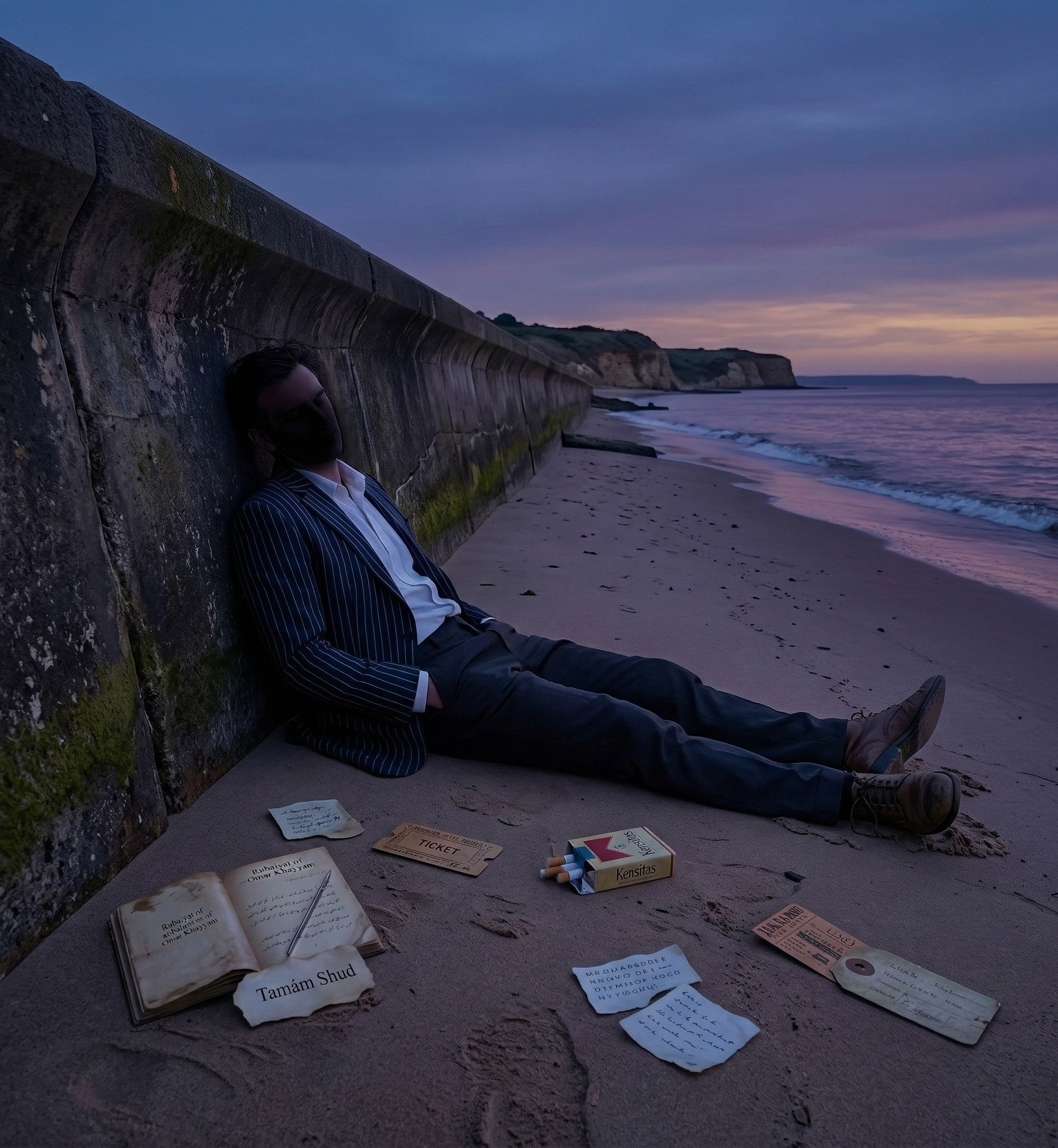
On December 1, 1948, beachgoers at Somerton Beach in South Australia found a well-dressed man against the concrete seawall opposite the Somerton Crippled Children's Home. Around 6:30 a.m., John Bain Lyons, a local jeweller, and another person discovered the body. Witnesses had seen the man in that position the previous evening, between 7:00 and 8:00 p.m., and assumed he was sleeping, delaying intervention.
Upon closer inspection, police found the scene oddly serene. The deceased, a strong man of "Britisher" appearance, estimated in his mid-forties, with greying ginger-brown hair and broad shoulders, showed no signs of struggle, violence, or distress. His legs were outstretched, and his feet crossed. The undisturbed sand reinforced the impression that he slipped away in his sleep.
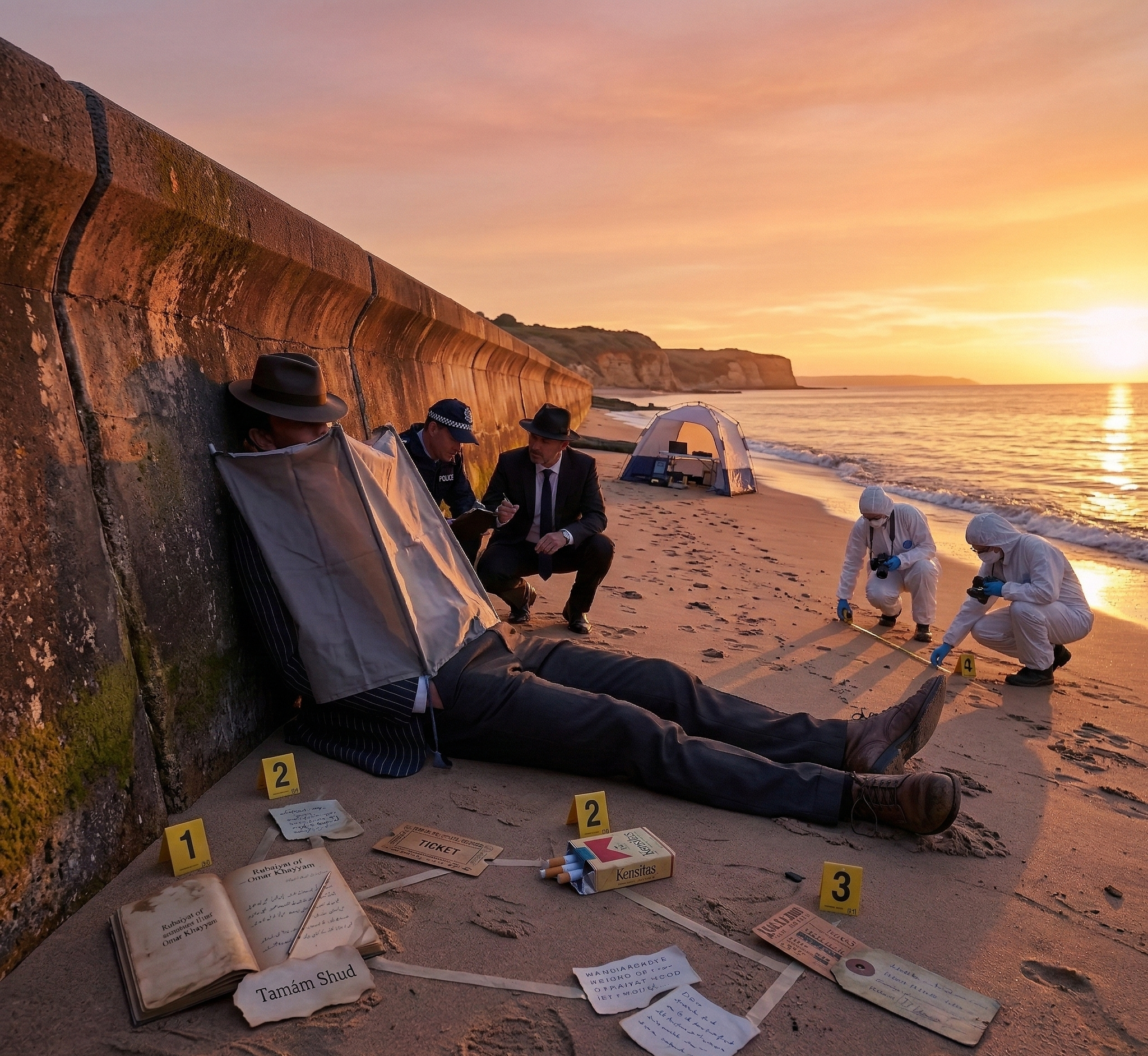
However, the tranquil scene contrasted with several unusual details. Despite the warm weather, the man wore a shirt, tie, pullover, and double-breasted coat. All labels had been meticulously removed from his clothing. His pockets contained unused train and bus tickets, combs, chewing gum, matches, and cigarettes, yet there was no wallet, money, or identification. His brown lace-up shoes were exceptionally polished, which seemed improbable for someone traversing dusty streets and sandy beaches. A half-smoked, unlit cigarette rested on his right coat collar, as if it had fallen there at the moment of death.
At first, police assumed natural causes or suicide. The hospital doctor recorded heart failure as likely. However, the autopsy found a swollen spleen and a blood-congested stomach, suggesting an undetectable poison. Toxicology found no known substances, and fingerprint searches were fruitless, leaving the case a mystery.
The Man Without an Identity
Police moved the unidentified body to the Royal Adelaide Hospital and then the mortuary, expecting easy identification. Instead, new questions arose. His pockets held an unused railway ticket, a used bus ticket, an aluminium comb, chewing gum, matches, and a packet of more expensive cigarettes. There was no cash, passport, or identification. Nearly all clothing labels were deliberately removed. The only exception was a pocket repaired with orange waxed thread, offering no answers. These efforts suggested an intention to conceal his origins, turning him into a deliberate enigma.
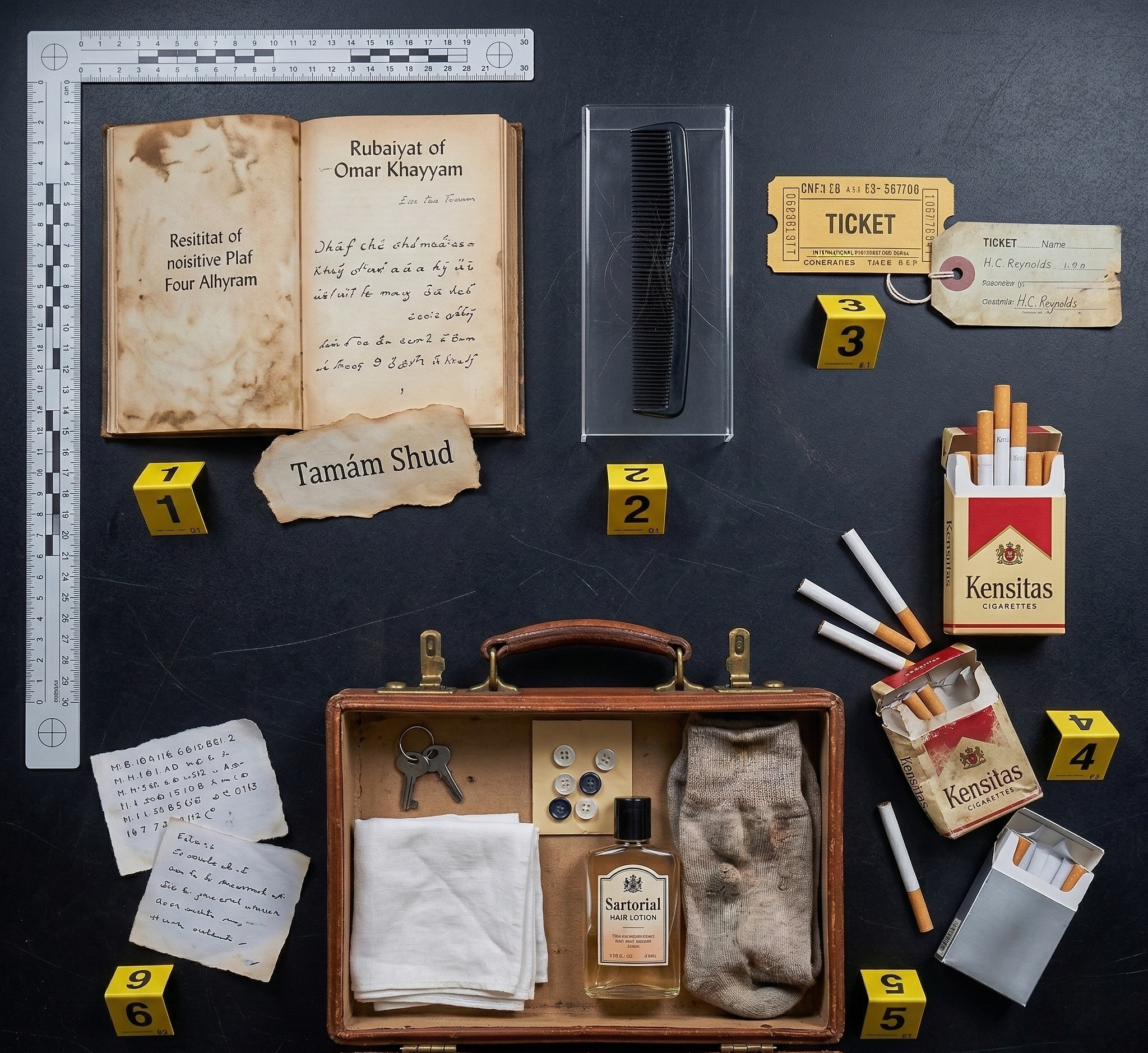
Police photographer and fingerprint expert Patrick James Durham took fingerprints on December 3. Authorities expected to identify the man, but no match was found locally, nationally, or internationally. Records were even sent to Scotland Yard and the FBI. In January 1949, the FBI confirmed no match existed.
Residents of Adelaide were invited to view the embalmed body, but all identification attempts were unsuccessful. Dental records also failed to yield a match. The Somerton Man appeared to have deliberately erased his identity. Lacking a name, wallet, or clothing labels, the investigation rapidly evolved into a case that both captivated the public and confounded law enforcement.
The Tamam Shud Note
Several months into the investigation, authorities made an important discovery. Specifically, in April 1949, pathologist John Burton Cleland found a concealed fob pocket sewn into the man's trousers that held a tightly rolled scrap of paper.
The paper bore two words in ornate script: "Tamám Shud." Police consulted experts, who quickly identified it as Persian for "it is ended" or "finished." They traced it to the final page of The Rubáiyát of Omar Khayyám, Edward FitzGerald’s 1859 translation, which reflects on life's brevity and the embrace of death. This theme supported theories of a planned suicide at the beach.
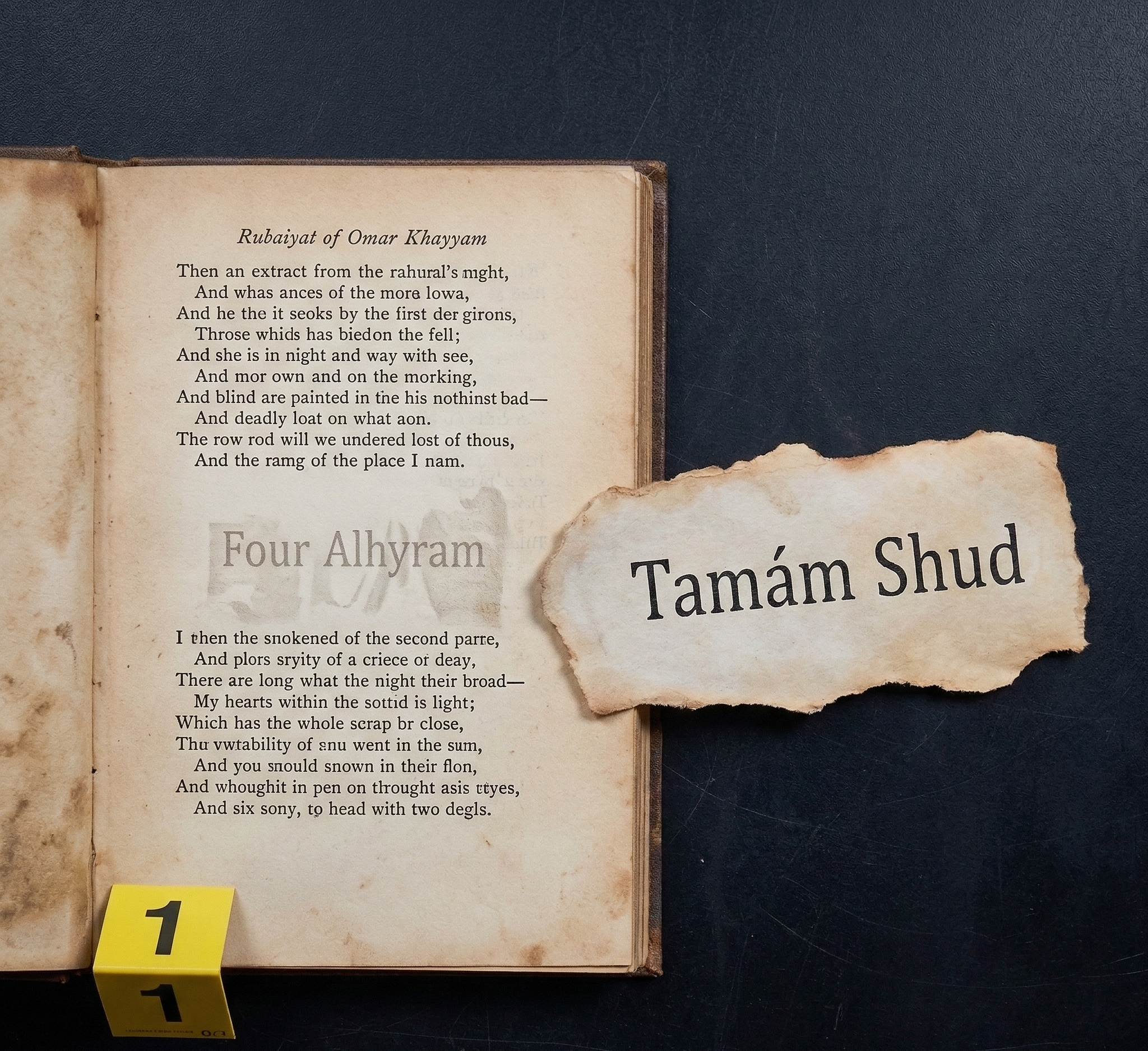
Determined to find the source, police launched a nationwide search for the book. In July 1949, a man produced a rare Whitcombe and Tombs edition of the Rubáiyát, saying it had been thrown into his parked car near Somerton Beach. Microscopic examination confirmed the page tear matched the scrap in the man's fob pocket.
However, the discovery of the book introduced further complexity. Detectives observed faint indentations on its back cover, which, when examined under ultraviolet light, revealed two unlisted phone numbers and five lines of handwritten capital letters, such as "MRGOABABD" and "MTBIMPANETP." One line was crossed out, suggesting the presence of a code. One of the phone numbers was traced to Jessica Thomson, a nurse residing near the beach. The case, initially considered a straightforward death, now involved a potential code and a secret local connection, suggesting possible links to espionage and romance.
The Cypher-
When detectives located the book linked to the Somerton Man, they found a detail that shifted the investigation. On the inside back cover, faint indentations became visible under UV light: five lines of handwritten capital letters, arranged like a hidden code. The code read: WRGOABABD MLIAOI (this line struck out) WTBIMPANETP MLIABOAIAQC ITTMTSAMSTGAB. A small "X" was drawn above the final "O" in the fourth line, deepening the confusion.
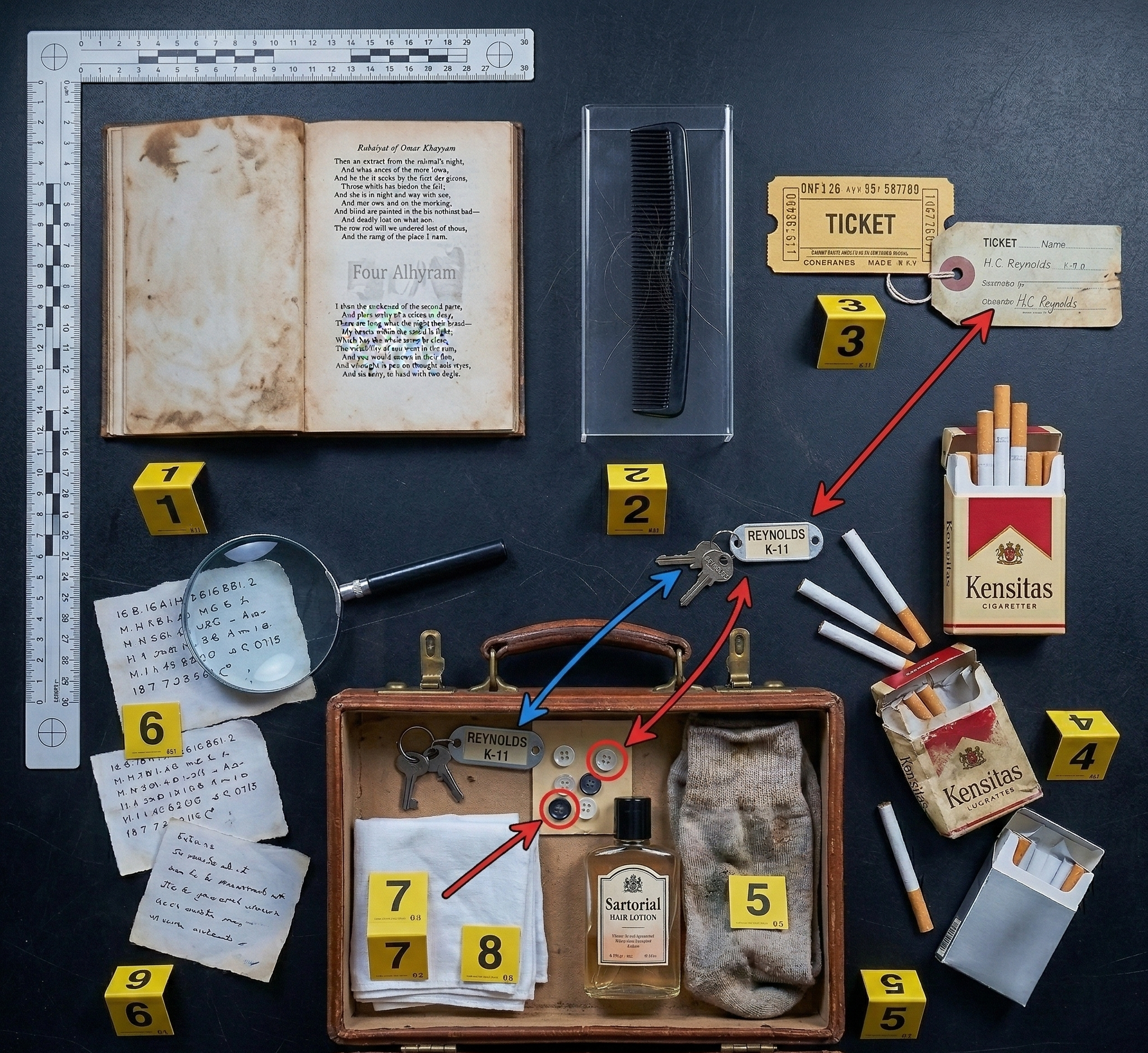
The presence of these cryptic lines shifted the case from a local suspicious death to an international cryptographic investigation. South Australian Police, considering the possibility of espionage, enlisted the help of cryptographers and forwarded the code to Australian Naval Intelligence. The case subsequently attracted the attention of agencies such as the FBI, Scotland Yard, the CIA, and the NSA.
Despite the best efforts of these professional cryptologists and a global frenzy of amateur codebreakers, no definitive solution has ever been confirmed. Conventional cryptographic techniques, such as substitution and transposition schemes, failed. Experts noted that the letter frequencies did not match standard English-language patterns, and the text was far too short to yield a clear decryption key. In 1949, Naval Intelligence concluded that the letters did not constitute a simple cypher; instead, they theorised that the lines might represent the initial letters of words in a poem, or some other form of personal shorthand.
Over subsequent decades, alternative theories have been proposed to explain the enigmatic sequence. Some researchers have posited that the letters constituted a "one-time pad" encryption commonly used in espionage. More recently, investigators have suggested that the code may have served as a personal mnemonic, representing either the names of racehorses on which the man placed bets or the initials of South Australian railway stations corresponding to his travel routes while searching for his estranged wife. However, as none of these theories has been conclusively validated, the meaning of the mysterious letters remains unresolved.
The Woman Called ‘Jestyn”
When detectives examined the faint pencil indentations on the back cover of the discarded Rubáiyát of Omar Khayyám, they discovered an unlisted telephone number alongside the enigmatic cypher. Tracing this number provided police with a significant lead: it belonged to a young nursing student named Jessica Ellen "Jo" Thomson. In early police reports and media coverage, authorities protected her identity by referring to her only as "Jestyn." Notably, Thomson resided on Moseley Street in Glenelg, approximately 400 meters from the location on Somerton Beach where the unidentified man's body was found.
When detectives questioned Thomson, she acknowledged owning a copy of The Rubáiyát while working at a Sydney hospital during World War II, and that she had given it to Australian Army lieutenant Alf Boxall in 1945. Police located Boxall in Sydney, who was alive and still in possession of the intact book. This indicated that the Somerton Man had a different copy, yet it contained Thomson’s unlisted phone number. When presented with a plaster cast of the deceased's face, Thomson reportedly exhibited a strong emotional reaction, appearing "completely taken aback to the point of giving the appearance that she was about to faint."
Despite her emotional reaction and refusal to view the bust again, Thomson denied any knowledge of the deceased or any understanding of why he possessed her contact information or visited her street. She requested anonymity to safeguard her reputation, and authorities honoured this request. Following the interview, retired detective Gerry Feltus concluded that she may have withheld critical information. Many investigators maintain that "Jestyn" was aware of the Somerton Man's identity, a secret she preserved until her death in 2007.
The Espionage Theory
The timing of the Somerton Man's death in December 1948 gave fertile ground for one of the case's most enduring and sensational hypotheses: the espionage theory. Occurring during the fraught early days of the Cold War, the mystery took place against a backdrop of escalating international paranoia and raised fears of Soviet infiltration. The year of his death coincided with a massive reorganisation of Australian intelligence operations. Intercepted communications from the top-secret Venona project had recently revealed that confidential Australian government information was being leaked to the Soviet Union by a spy ring operating within the country. This shocking discovery prompted a severe crackdown on espionage and led to the eventual establishment of the Australian Security Intelligence Organisation (ASIO) in 1949.
Geographically, Adelaide was a city of immense strategic interest. It was situated relatively close to two highly classified and sensitive sites: the Radium Hill uranium mine, one of the few known sources of uranium in the world at the time and the Woomera Test Range, a remote Anglo-Australian military research facility dedicated to experimental rocket testing. The presence of these secretive operations meant that foreign intelligence agencies had a vested interest in South Australia, leading many to suspect that the unknown man was a Soviet spy, a black-market smuggler of atomic secrets, or an intelligence courier.
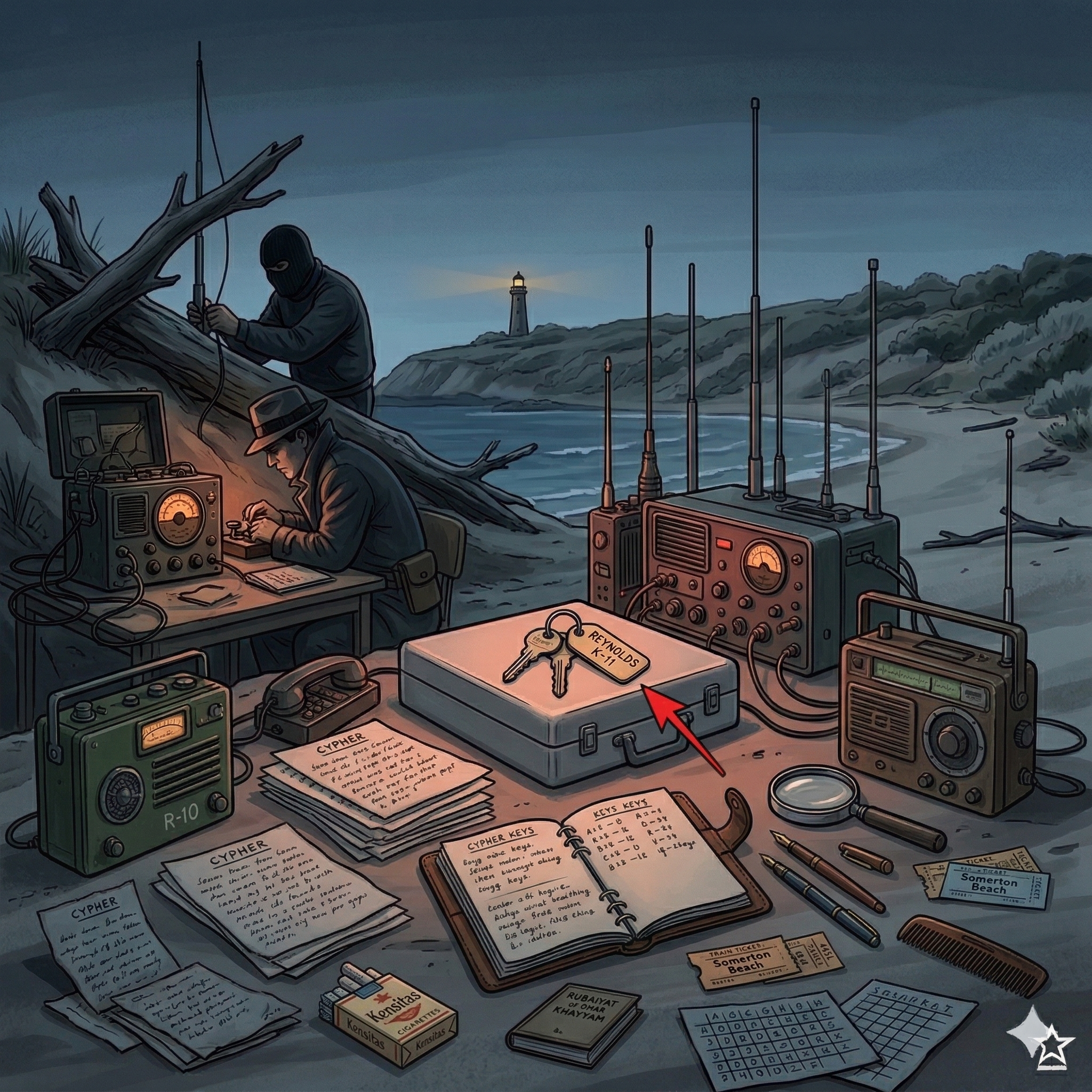
The physical evidence reinforced espionage theories. The Somerton Man's lack of identification and the removal of clothing labels were consistent with intelligence tradecraft. The five lines of letters in The Rubáiyát resembled a cypher or "one-time pad" encryption, a method commonly associated with espionage. In the minds of Cold War conspiracy theorists, only a sophisticated foreign intelligence network could have executed such a traceless, quiet murder.
Despite substantial circumstantial evidence and decades of investigation by agencies including the FBI, Scotland Yard, and ASIO, no definitive conclusions were reached. No foreign government claimed the Somerton Man, and professional cryptographers were unable to decode his supposed cypher into meaningful intelligence. Although the recent DNA identification of the man as Carl Webb, a Melbourne electrical engineer, suggests a domestic tragedy rather than an international espionage case, the espionage theory persists as a compelling aspect of the case's enduring narrative.
The Long Silence of the Case
Following initial investigative efforts and international appeals, the case stagnated and remained unresolved for decades. Despite sustained public interest and continued investigation, the available clues, including removed clothing labels, the missing wallet, and the Rubáiyát connection, yielded no definitive answers. The individual became known as the Somerton Man, representing a persistent enigma in Australian criminology.
In the unavailability of concrete facts, investigators pursued a variety of conflicting hypotheses, beginning with complex poison theories. The autopsy's revelation of severe internal congestion strongly pointed to a lethal toxin, yet the complete failure of toxicologists to identify a specific substance spawned rumours that a rare, undetectable poison like strophanthin or digitalis had been used. Because no signs of a struggle were found and the man appeared to have died peacefully, authorities and the public alike leaned heavily toward suicide theories. The discovery of the "Tamám Shud" scrap, translated as "it is finished", seemed to serve as a poetic suicide note from a man who had intentionally wiped his identity before taking his own life.
However, the international atmosphere of the late 1940s gave fertile ground for much darker speculations. Unfolding amid the early paranoia of the Cold War, the case led many to suspect links to intelligence. Adelaide’s proximity to highly classified sites like the Woomera Test Range and the Radium Hill uranium mine fueled rumours that the Somerton Man was a Soviet spy or a black-market smuggler. The cryptic sequence of letters found on the back of the discarded Rubáiyát was widely interpreted as an unbreakable cypher or a one-time pad used in covert espionage.
In parallel to the espionage angle, investigators also pursued romantic motives. The unlisted phone number pencilled in the poetry book linked the dead man to Jessica "Jestyn" Thomson, a local nurse who lived just a short walk from where the body was discovered. When it was observed that her son, Robin, shared rare anatomical anomalies with the Somerton Man, specifically missing lateral incisors and unusual ear shapes, many concluded the Somerton Man was a spurned lover who had travelled to Adelaide to seek out his illegitimate child.
Although multiple theories, including poisoning, suicide, espionage, and romance, have been proposed, none have been conclusively substantiated. The true circumstances surrounding the Somerton Man's death remain unresolved, and he continues to serve as a symbol of enduring mystery.
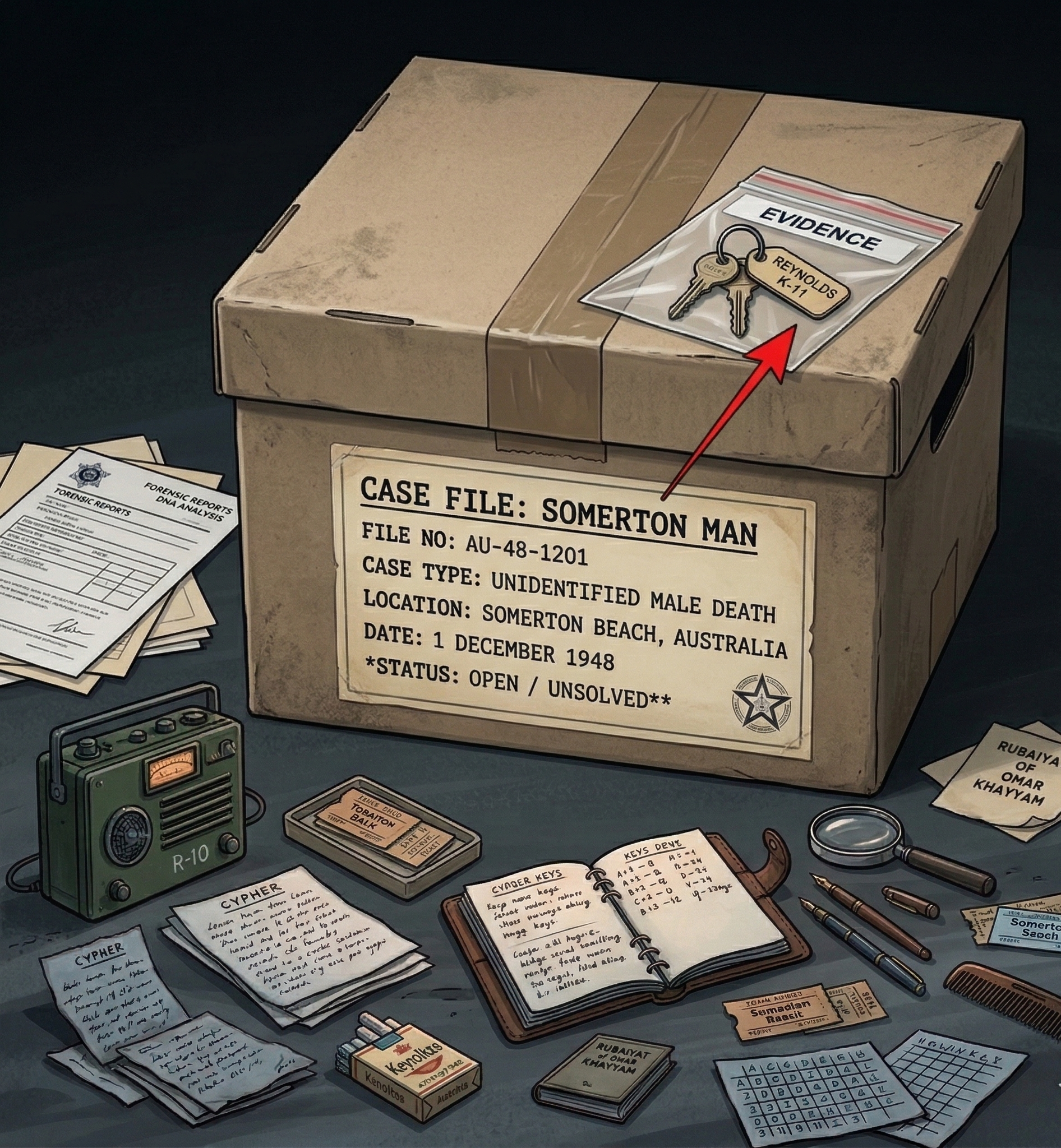
DNA and the Modern Breakthrough
For decades, the Somerton Man remained buried in anonymity until modern forensic genealogy produced a significant breakthrough. In 2022, University of Adelaide professor Derek Abbott and forensic genealogist Colleen Fitzpatrick announced that they had identified the unknown individual. Utilising DNA extracted from several strands of rootless hair preserved in the plaster death mask created by police in 1949, the researchers constructed a family tree comprising approximately 4,000 individuals to trace his lineage.
The genomic evidence pointed to a single, previously undocumented man: Carl "Charles" Webb. Born in Footscray, Victoria, in 1905, Webb was an electrical engineer and instrument maker from Melbourne. This professional background perfectly accounted for the specialised tools found in the Somerton Man's suitcase, such as the sharpened scissors, the modified table knife, and the stencilling brush. Furthermore, genealogical research revealed that Webb's sister was married to a man named Thomas Keane, seamlessly explaining the "T. Keane" name tags deliberately left on a few items of clothing.
However, identifying the Somerton Man raised further questions. Archival research suggests a domestic motive: Webb separated from his wife, Dorothy, in 1947, after which she moved to South Australia. He may have travelled to Adelaide to find her. Researchers also noted Webb's interest in poetry and horse racing, leading to the hypothesis that the code in The Rubáiyát could represent racehorse initials or a personal travel record.
Despite these significant developments, the case remains unresolved, and the Somerton Man remains a profound mystery. South Australian authorities, having exhumed the body in 2021, have not yet officially confirmed the identification or released a final coronial report regarding the precise cause of death. Although his name is now known, the circumstances surrounding the events on Somerton Beach in 1948 remain unclear. The mystery is closer to resolution, yet the true nature of Carl Webb, who crossed his feet, placed a half-smoked cigarette on his collar, and carried a poem of conclusion in his pocket, remains Tamám Shud: finished, yet unsolved.

References
Balint, R. (2010). The Somerton man. In Cultural Studies Review (pp. 159–178) [Journal-article]. http://epress.lib.uts.edu.au/journals/index.php/csrj/index
Bauer, C. P. (2017). Unsolved! : the history and mystery of the world’s greatest ciphers from ancient Egypt to online secret societies [Book]. Princeton University Press. https://lccn.loc.gov/2016027673
Code Cracking: Who murdered the Somerton man? (2021). [Thesis]. In Final Thesis (p. 1).
Feltus, G. M. (2010). The Unknown Man - (A suspicious death at Somerton Park) (B. O O’Neil, MA, MPHA, Ed.) [Book]. Gerald Michael Feltus. https://www.theunknownman.com (Original work published 2010)
Greenwood, K. (2012). Tamam Shud: the Somerton man mystery. In OceanofPDF.com [Book]. NewSouth Publishing. https://OceanofPDF.com
Tamam shud - The Somerton Man Mystery Research. (n.d.). https://astraeiform20.rssing.com/chan-10861038/all_p12.html
Tamám Shud Case: The Mystery of the Somerton Man | Into Horror History | J.A. Hernandez. (n.d.). https://www.jahernandez.com/posts/tamam-shud-case-the-mystery-of-the-somerton-man