Belle Gunness: The Widow Who Dug Graves.
Lady Bluebeard: The Woman Who Buried Love Alive
History remembers many notorious figures, but few are as chilling as Belle Gunness. Born on 11 November 1859 in Selbu, Norway, she was the youngest of eight children.
Gunness reportedly experienced an unremarkable childhood; one unverified account alleges she was assaulted by a man, resulting in the loss of her unborn child. If accurate, this event may have influenced her later psychological development.
Determined to escape poverty, Gunness saved for years to emigrate. At 22, she left Norway for Chicago, took the name Bella Petersen, and worked as a servant. Her marriage to Mads Sørensen began her transformation into a notorious serial killer.
This article moves beyond folklore to analyse Belle Gunness’s crimes, examining the historical context and forensic limitations of her time to better understand how she operated her deadly 'lonely hearts' scheme. Gunness defied typical female serial killer profiles. While most killed quietly, she combined financial motive with brutal violence. This analysis distinguishes fact from myth by reviewing her motives, methods, and the mystery of her fate after the 1908 fire.
The Immigrant Who Built a New Life
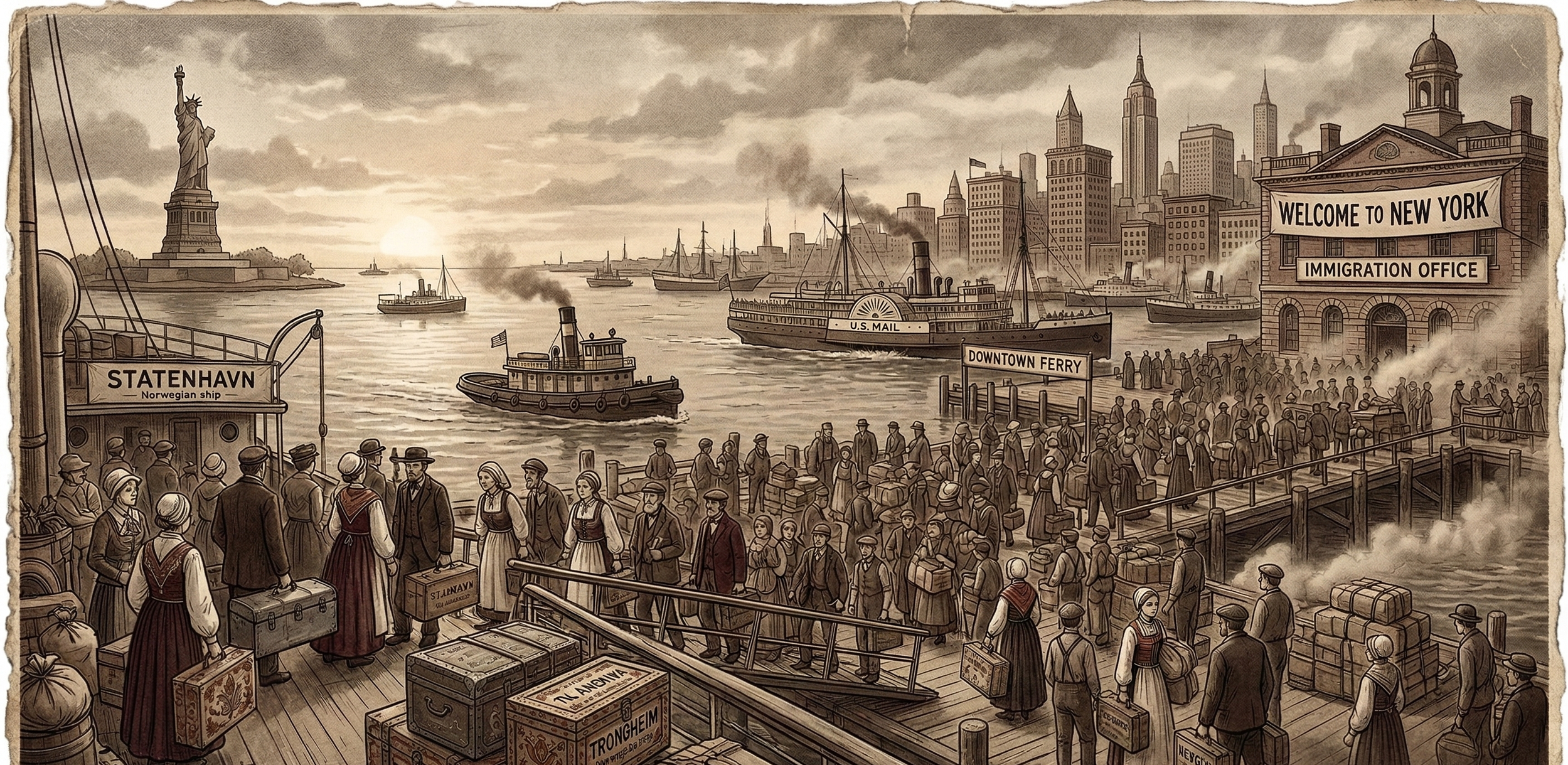
After the 1871 fire, Chicago rebuilt quickly, earning a reputation as a 'magnet metropolis' by the early 1880s and attracting young people seeking opportunity. Many immigrants, including Norwegians, came to Chicago. They were among the early settlers when Chicago was a small settlement on Lake Michigan.
Belle Gunness, born Brynhild Paulsdatter Størseth in Norway, was part of Chicago’s Norwegian community. Her father farmed a leased plot, raising animals and crops. The family just barely survived. Norwegian immigrants had difficulty adjusting, but Belle had support. Her sister Olina (Nellie) lived in Chicago with her husband and hosted Belle as she established herself.
Belle, like many Scandinavian women in Chicago, worked as a laundress, seamstress, and servant, contributing her wages to the Larsons. Her experience with farmwork matched these jobs, but she sought greater prosperity as Chicago developed. Driven by poverty, Belle prioritised wealth in a spouse and married Mads Sørensen, a night watchman. The couple briefly ran a confectionery store, which was destroyed by fire, and later their house was destroyed by fire. Each time, they collected insurance payments—marking the start of Belle’s deadly pattern of financial fraud. Belle became known for offering to care for orphaned or abandoned children at local events.
The couple could not have biological children, so they fostered and adopted several. Tragically, two foster children, Caroline and Alex, died in 1896 and 1898. Their deaths were officially attributed to "colitis," but some modern experts believe the symptoms may have indicated poisoning. Belle also collected life insurance payouts after their deaths. A similar pattern followed with Mads Sørensen's death on July 30, 1900. He had purchased life insurance, and Belle allegedly prompted him to buy a larger policy. One day, both policies overlapped, and Mads died suddenly. Belle said he returned home with a headache; she gave him "quinine powder," and later found him dead.
Though Mads’s family requested an inquiry, and one doctor suspected poisoning, the official cause was cerebral haemorrhage or heart failure. No charges were filed. Belle collected payouts from both insurance policies and, amid local suspicion, moved to La Porte, Indiana, with her three surviving foster children to buy a 43-acre pig farm.
The Lonely-Hearts Advertisement
In November 1901, Gunness moved to La Porte and lived at the pig farm on McClung Road. She brought three surviving children: Myrtle, Lucy, and a foster daughter named Jennie Olson. On April 1, 1902, she married her second husband, Peter Gunness, a recent widower with two daughters. The fatal pattern from Chicago accelerated. Within a week of the marriage, Peter’s infant daughter died of unknown causes in Belle’s care. Eight months later, in December 1902, Peter Gunness himself suffered fatal trauma.
Belle’s account of Peter’s death—a sausage grinder and crock falling on him—drew local scepticism. Still, her display of grief and a lack of evidence resulted in no charges. She received $3,000 in insurance. After her second husband’s death, Gunness moved from family insurance fraud to a wider 'Lonely Hearts' scheme. She placed ads in Norwegian-language newspapers targeting wealthy bachelors and widowers. The ads described a widow with a prosperous farm seeking a serious, affluent husband, warning: 'triflers need not apply.' This attracted targets ready to bring their savings to her property.

Gunness manipulated interested men through letters, fostering false intimacy and urgency. She urged them to liquidate assets, travel to La Porte with cash, and keep plans secret. After surrendering funds, the suitors vanished. When questioned, Belle claimed they left with traders or moved to Chicago.
As Belle Gunness’s criminal enterprise expanded, Ray Lamphere became a significant presence. Hired in August 1907 as a farmhand on her La Porte property, Lamphere also became Gunness’s intermittent romantic partner. He sought a more permanent role on the prosperous farm, but his ambitions were consistently undermined by the continued presence of affluent bachelors at the property.
The Farm That Swallowed Men
The 43-acre La Porte pig farm appeared peaceful but soon became infamous for disappearances. Locals noticed wealthy men arriving but never leaving. Belle’s strength—she could reportedly lift 100-pound hogs—enabled her secret activities.
Belle’s strange instructions to dig shallow trenches on the property went unexplained until Andrew Helgelien vanished in January 1908 after arriving with $2,900, which Belle withdrew before his disappearance. His brother, Asle, suspicious, confronted Belle, who claimed Andrew had simply left town. With help from a former farmhand, Asle Helgelien and investigators searched soft spots in the hog pen, where livestock odours concealed decomposing bodies. They discovered a gunnysack, which Asle identified as containing his brother’s remains.

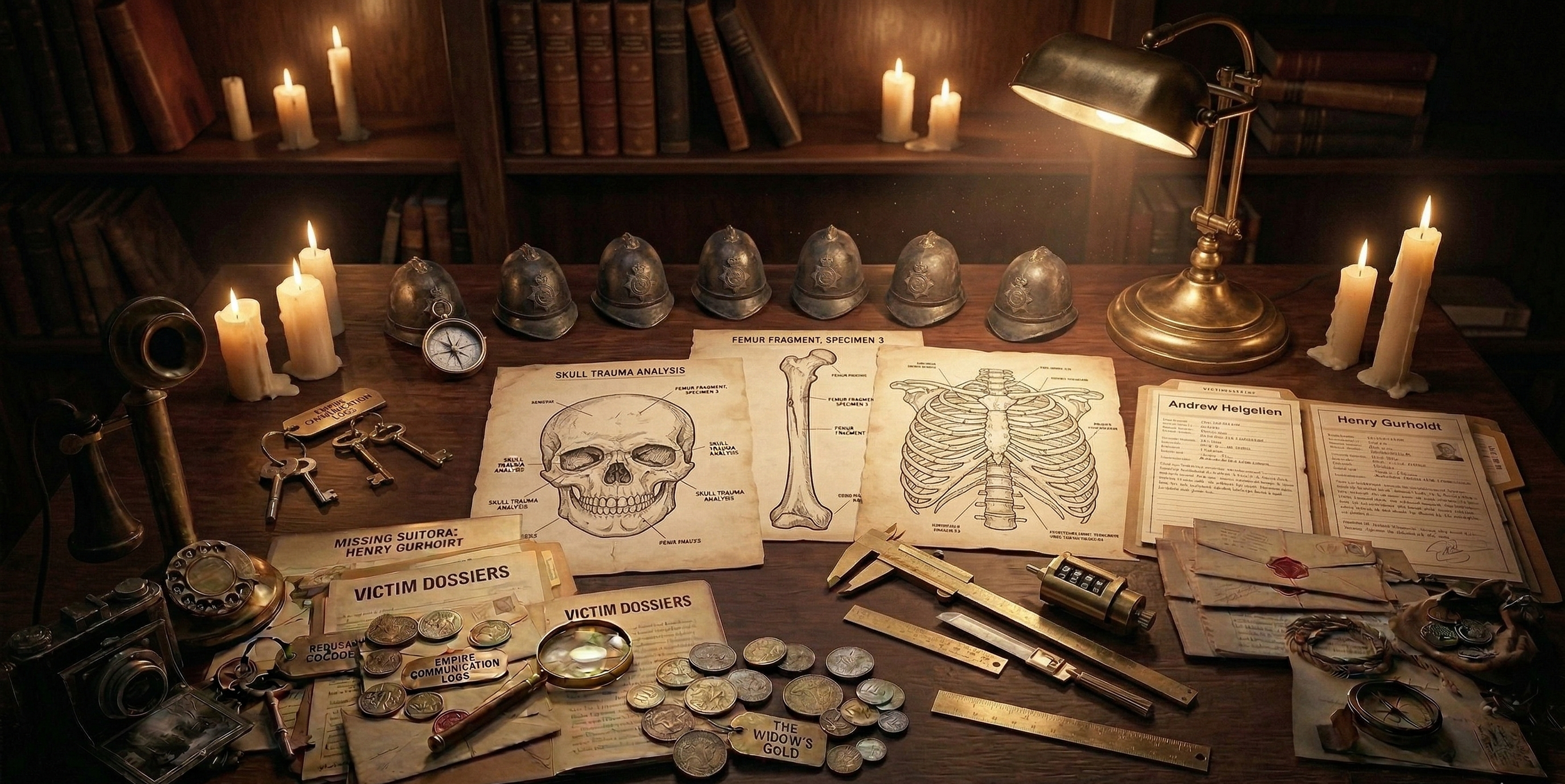
As police continued to excavate the pig pen, outhouse, and surrounding gardens, the full extent of the "murder farm" was revealed. Authorities uncovered numerous depressions containing burlap sacks filled with dismembered torsos, severed limbs, and human bones. The bodies had been butchered with anatomical precision, with arms decapitated at the shoulders and legs severed at the knees before being buried with quicklime and covered in cement. Ultimately, the remains of more than a dozen victims, including missing suitors and children, were recovered, transforming the Indiana pig farm into a site of unprecedented horror.
Fire in La Porte- 1908
On the early morning of April 28, 1908, the quiet rural scenery of La Porte was violently interrupted by a blazing inferno that would ultimately expose one of the nation's most prolific killers. Around 4:00 a.m., the newly hired farmhand, Joe Maxson, awoke to the biting smell of smoke filling his room. He desperately attempted to rouse his employer and her family, calling into the smoke-filled hallways, but received no answer. Barely escaping with his own life, Maxson could only watch helplessly as the massive farmhouse was entirely consumed by the flames. By the time the fire was extinguished, the structure had burned to the ground, leaving only a smouldering brick foundation and a cellar filled with ash and debris. The local community, initially viewing the event as a catastrophic rural tragedy, rallied to help investigators search the blackened ruins for survivors or remains.

When the authorities finally sifted through the cooled rubble of the basement later that afternoon, they made a horrific discovery. Lying together within the ashes were four charred bodies. Three of the victims were quickly identified as Gunness's children: five-year-old Philip, nine-year-old Lucy, and eleven-year-old Myrtle. While the fire itself was devastating, subsequent toxicological testing on the children's remains revealed a much darker, much more sinister reality. The children had not died from smoke inhalation or the flames; they had been deliberately poisoned before the blaze. That grim detail immediately altered the narrative from a tragic accident to a calculated, cold-blooded murder, suggesting that the fire was intentionally set to cover up the killings of the children.
Lying alongside the children was a fourth body, an adult female initially presumed to be the tragic victim of the fire, Belle Gunness herself. However, this corpse presented a disturbing and baffling anomaly: it was completely headless. The skull was nowhere to be found in the debris, rendering a positive visual identification impossible. Furthermore, the corpse's physical dimensions sparked immediate and intense controversy. Belle Gunness was a notoriously large, physically imposing woman, standing around 5 feet 8 inches tall and weighing roughly 230 to 250 pounds.
The physician who conducted the postmortem examination, along with several witnesses, testified that the headless body recovered from the cellar was approximately five inches shorter and at least fifty pounds lighter than Belle Gunness. The only evidence linking the corpse to Belle was a set of false teeth and dental crowns found in the ruins, which showed no signs of exposure to intense heat, leading many to suspect they had been deliberately placed.
The Body That Did Not Fit
When investigators sifted through the smouldering ruins of the La Porte farmhouse, they made a grisly discovery in the cellar: the charred remains of three children alongside a headless adult female. Initially, authorities assumed this was the tragic end of Belle Gunness, but the physical dimensions of the corpse immediately triggered intense controversy. Belle was a notoriously large and physically imposing woman, standing between 5 feet 7 inches and 5 feet 8 inches tall and weighing roughly 210 to 250 pounds. But the doctor who did the post-mortem examination verified that the body found under the rubble was 5 inches shorter and 50 pounds lighter. To further aggravate matters, the woman's head was nowhere to be found, rendering a positive visual identification impossible.
The only physical evidence linking the corpse to Belle was a dental bridge with porcelain teeth and gold crowns, found among the ashes. Although a dentist identified the bridgework as belonging to Gunness, sceptics suspected she had deliberately planted the dentures alongside the corpse to mislead investigators and stage her own death. This theory was later supported by Ray Lamphere, Belle's former farmhand, who claimed she had lured a woman from Chicago to serve as a body double, murdered and decapitated her, and then fled the inferno with a suitcase full of cash.
Ray Lamphere and the Investigation
Immediately following the devastating fire, authorities zeroed in on Lamphere. Belle had perfectly framed him by visiting her attorney just the day before the blaze to formally state that he was unstable and threatening her life. This tactical manoeuvring, combined with Lamphere being seen suspiciously close to the farmhouse when the fire broke out and his admission of seeing the flames without raising the alarm, led to his swift arrest. The physical evidence tying him to the farm's darker secrets was also damning; at the time of his apprehension, police discovered that Lamphere was wearing the heavy overcoat of the missing suitor, John Moe, and carrying Henry Gurholt's watch.
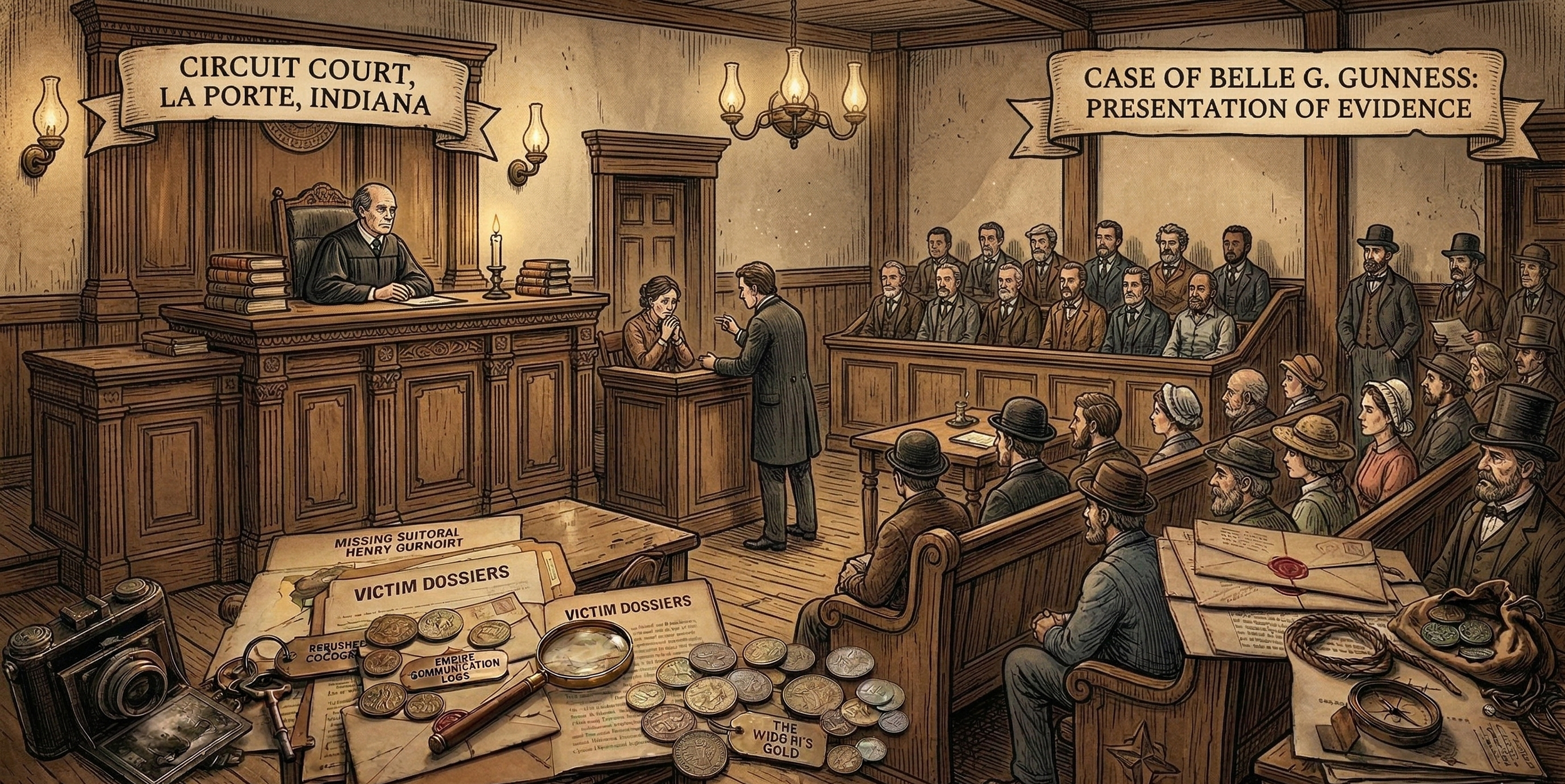
During his trial at the La Porte County Courthouse in November 1908, two competing narratives emerged. The prosecution claimed that Lamphere, driven by a jealous rage over Belle's revolving door of suitors, had set the house ablaze to murder her and the children. Lamphere's defence team, however, presented a much more sinister theory: Belle had precisely orchestrated the entire inferno, murdering another woman to serve as a body double, decapitating the victim to prevent identification, and fleeing with her accumulated wealth. The jury's verdict ultimately reflected the ambiguity of the forensic evidence. Because it was determined that the four victims in the cellar had been poisoned or bludgeoned to death before the fire was even ignited, and because the headless corpse could not be definitively identified as Belle, Lamphere was acquitted of the murder charges. He was, however, found guilty of arson and sentenced to the Indiana State Prison in Michigan City.
Lamphere did not survive his sentence, dying of tuberculosis in 1909, but he contributed to the enduring mystery of the "murder farm." Before his death, he provided a detailed confession to Reverend Edwin Schell, a local Methodist minister. In his final statements, Lamphere confirmed the extent of Gunness's criminal enterprise, describing how she used matrimonial advertisements to lure, rob, and murder her victims. He also confessed to assisting Belle in planting the decoy body, poisoning the children, and setting the farmhouse on fire.
Did Belle Gunness Escape?
Whether Belle Gunness died in the 1908 fire or successfully staged her own disappearance remains one of America's most enduring true-crime mysteries. After the discovery of her crimes, rumours circulated that a smaller woman's body had been substituted for her own, and that Gunness had set the fire and escaped with her fortune. For decades, reported sightings of Gunness were documented across the United States.
A prominent theory regarding Gunness's survival emerged in 1931, when a woman named Esther Carlson was arrested in Los Angeles for poisoning an 81-year-old man with strychnine to steal his savings—a method like Gunness's. Carlson died of tuberculosis in custody before trial. Suspicion intensified when two former La Porte residents identified Carlson's body as Belle Gunness, and police reportedly found photographs of the Gunness children in Carlson's trunk. However, modern researchers later discovered records placing Carlson in Connecticut between 1890 and 1908, when Gunness was active in Chicago and Indiana, casting doubt on the connection.
The Silence Beneath the Farm
Upon completing their excavation of the burned ruins of Belle Gunness’s farm in La Porte, Indiana, investigators uncovered not a single crime scene, but a graveyard. Beneath the soil were the remains of men who had arrived seeking new beginnings, only to fall victim to a woman who systematically exploited loneliness, deception, and death.
Among the confirmed victims were Mads Sorenson, Belle’s first husband, whose death conveniently coincided with overlapping insurance policies. Later came Peter Gunness, her second husband, who died under suspicious circumstances after a so-called farm accident. But the list did not end. When authorities finally excavated the hog pen and surrounding property following the 1908 farmhouse fire, the gruesome fate of these missing suitors was revealed. The butchered, dismembered remains of numerous men who had answered her advertisements were unearthed, including Wisconsin farmhand Henry Gurholt, John Moe of Minnesota, Ole B. Budsberg, Olaf Svenherud, George Berry, and Olaf Lindbloom. The catalyst for this grisly discovery was the disappearance of Andrew Helgelien.
Alongside the remains of these affluent bachelors, investigators also discovered the bodies of children, including Gunness's teenage foster daughter, Jennie Olson, whom Belle had previously claimed had moved away to attend college. They joined the charred bodies of Gunness's children—Myrtle, Lucy, and Philip—found poisoned in the cellar ruins. While these named individuals represent the officially identified victims, the true scale of her slaughterhouse is still a mystery, with some figures indicating she murdered upwards of forty people.
Authorities estimated that Belle may have accumulated tens of thousands of dollars from her victims, a substantial sum for the early twentieth century. Some reports indicated that she required suitors to bring cash savings of $1,000 to $3,000, ostensibly to fund their future together. The money disappeared along with the men.
The final and most unsettling question remains unresolved. When Belle’s farmhouse burned in April 1908, the body found in the ruins was headless and significantly smaller than Belle herself. Although three of her children were confirmed dead, investigators could not conclusively identify the woman in the ashes as Belle Gunness. If the body was not hers, then the individual known as “Lady Bluebeard” may have escaped justice. The soil of the Indiana farm contained fragments of bones, broken lives, and evidence of calculated cruelty, but the complete truth about Belle Gunness may have perished with the farmhouse.
It remains possible that, far from La Porte, the woman responsible for so many deaths spent the remainder of her life in obscurity, while the names of her victims remained buried beneath the land she once called home.

References
Adams, Josh. (2008, May 20). "Remains of murderess' children exhumed." Forest Park Review.
Ammeson, Jane Simon. (2021). America's Femme Fatale: The Story of Serial Killer Belle Gunness. Red Lightning Books.
Biography.com Editors. (2023, October 3). "Belle Gunness: Biography, Serial Killer, Facts, Life & Victims." Biography.com, A&E Television Networks.
Butler, Ashley. (2015, May 10). "Bizarre but True." WildBlue Press True Crime Website.
Coffeen, Robert F. (1933). "Belle Gunness biography, 1933." Norwegian-American Historical Association Collections.
De la Torre, Lillian. (1955). The Truth about Belle Gunness: The True Story of Notorious Serial Killer Hell's Belle. Fawcett/Gold Medal Books (Reprinted by Open Road Media).
Edward J. Bennett Papers, ca. 1939-1995. Indiana Historical Society.
Harrison, Marissa A. (2023). Just as Deadly: The Psychology of Female Serial Killers. Cambridge University Press.
Johnson, Bruce R. "Belle Gunness." La Porte County Historical Society Museum.
"Lamphere Now Seeking Consolation Of Religion." (1908, May 2). The La Porte Argus-Bulletin. (Archived in the La Porte County Public Library Digital Collection).
"Letters Of Mrs. Gunness Tell Plotting Of Woman." (1908, November 17). The La Porte Argus-Bulletin. (Archived in the La Porte County Public Library Digital Collection).
Mitera, Mark-Christopher. (2007, December 4). "Hell's Belle." Forest Park Review.
Polk, Ashley. (2025). Masculine Traits in Female Serial Killers: A Qualitative Analysis. (Doctoral dissertation). ScholarWorks, Walden University.
Ramsland, Katherine. (2018, April 2). "Hell's Belle: Expert's new book on infamous female serial killer sets records straight." Psychology Today.
Schechter, Harold. (2018). Hell's Princess: The Mystery of Belle Gunness, Butcher of Men. Little A.
Shenfeld, Hilary. (2018, April 11). "What Really Happened to Belle Gunness, Serial Killer and Butcher of Men?" A&E Crime + Investigation.
"State Weaving Its Case In Ray Lamphere Trial." (1908, November 16). The La Porte Argus-Bulletin. (Archived in the La Porte County Public Library Digital Collection).
"The Lady Bluebeard of La Porte: A Socio-Forensic Analysis of the Belle Gunness Serial Homicide Case." Socio-Forensic Analysis / Case Study.
Whalbring, Marcus. (2008, February 6). "UIndy alum investigates if serial killer faked her own death." The Reflector, University of Indianapolis.
"Where is Belle Gunness?" (1908, June 25). The Macleay Chronicle (Kempsey, NSW). (Archived in Trove, National Library of Australia).
Wilkins, Melinda Page. (2004). A Comfortable Evil: Female Serial Murderers in American Culture. (Doctoral dissertation).