Blackfriars Bridge: The Banker, The Vatican, And The Silence
On the morning of June 18, 1982, a disturbing scene unfolded in London. A postal clerk on his regular route discovered a body suspended from yellow-painted scaffolding above the Thames at Blackfriars Bridge. The deceased was dressed in a high-quality grey suit with pockets, and bricks and masonry weighted down the trousers. Authorities recovered approximately $15,000 in British, Swiss, and Italian currency from his wallet. He also wore a gold Patek Philippe watch, which had stopped in the early hours. The circumstances of the scene indicated a death too symbolic to be regarded as a routine suicide.
A falsified passport found in his pocket bore the name “Gian Roberto Calvini.” However, the deceased was soon identified as Roberto Calvi, a 62-year-old financier of considerable influence. Calvi was not merely an anonymous victim; he served as chairman of Banco Ambrosiano, Italy’s most prominent privately owned bank, and was widely known as “God’s Banker.” This moniker reflected his clandestine relationship with the Vatican Bank, officially known as the Institute for the Works of Religion. While Banco Ambrosiano originated as a “priests’ bank” supporting charitable activities, Calvi expanded it into a global financial institution and became a key steward of the Holy See’s assets.
Calvi’s death was not an isolated incident but rather the manifestation of a broader crisis. As his body was discovered above the Thames, the financial empire he constructed through offshore accounts and concealed networks began to unravel. Over the preceding decade, Calvi established a complex web of shell companies spanning the Caribbean and Latin America. By June 1982, this network had resulted in $1.3 billion in unaccounted funds. The losses implicated three major entities: the Sicilian Mafia, which laundered heroin proceeds through his operations; the Propaganda Due (P2) Masonic lodge, which engaged in political violence; and senior Vatican officials, who provided covert “letters of comfort” to support illicit loans. Pursued by legal authorities and deserted by former associates, Calvi sought refuge in London. Concurrently, his secretary died after falling from a window in Milan.
Limiting the inquiry to whether Calvi’s death was a suicide or a homicide neglects the broader context. The central question concerns the conditions that enabled his death. The case illustrates the convergence of religious, political, and criminal interests. Official rulings have alternated between suicide and murder, while prominent trials in Rome concluded with acquittals due to insufficient evidence and uncooperative witnesses. Despite numerous investigations, institutional silence continues to obscure the truth.

The Body Beneath The Blackfriars Bridge
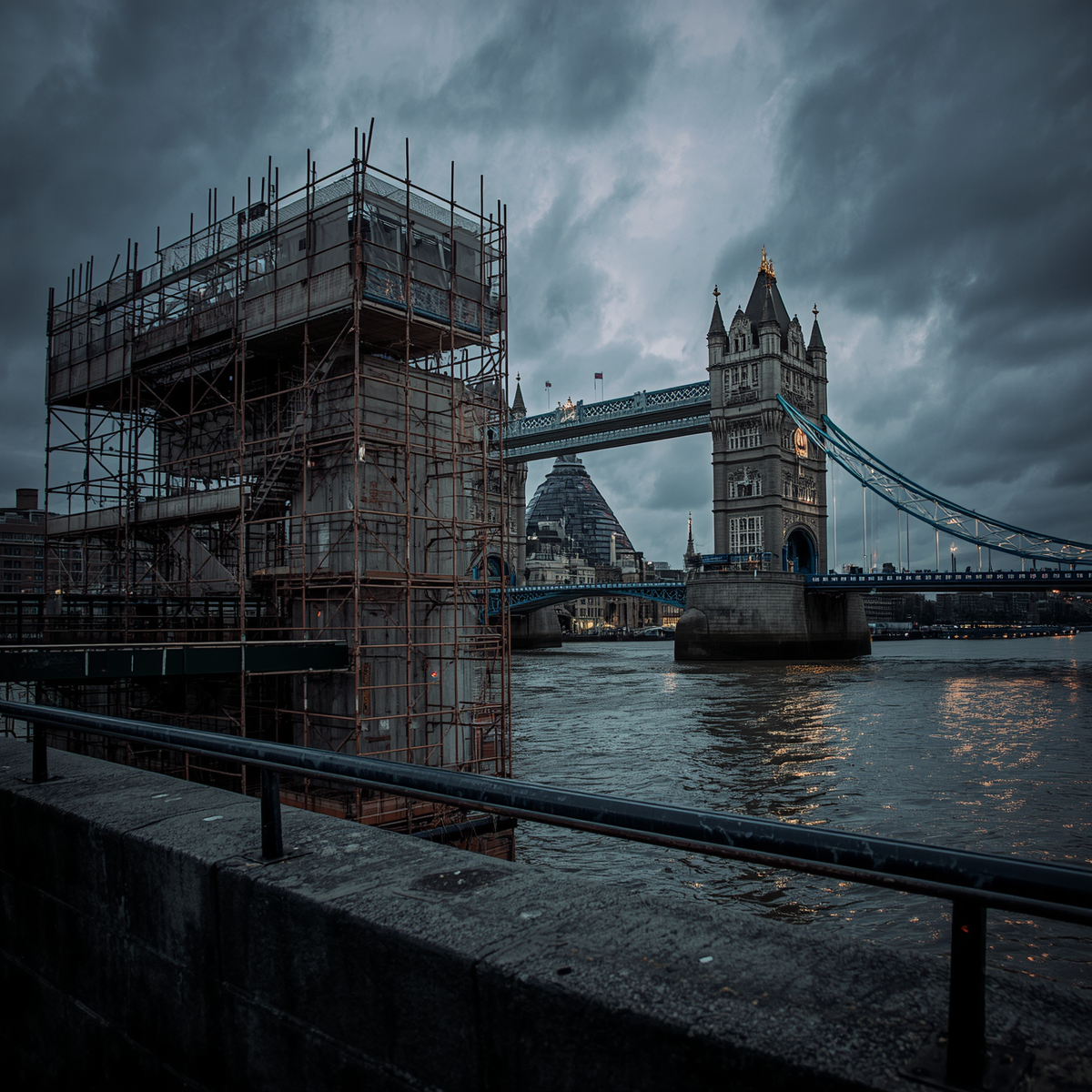
On the morning of Friday, June 18, 1982, Anthony Huntley, a postal clerk, was walking his regular route toward the Daily Express offices in central London. As he looked over the pale blue and white wrought iron parapet of Blackfriars Bridge, he observed the lifeless body of a man suspended from the yellow-painted scaffolding beneath the bridge’s north arch. An orange nylon rope was tightly secured around the man’s neck and fastened to the metal pipes with a lover’s knot. The river tide reached just below the deceased’s shoes.
The Thames River Police arrived shortly thereafter, removed the body, and transported it to Waterloo Pier. Upon examination, the unusual and deliberate staging of the death became apparent. The deceased was dressed in an expensive grey suit, with his clothing noticeably weighted by heavy objects. Investigators discovered approximately twelve pounds of stones and half-bricks distributed in his jacket, trouser pockets, and the front of his trousers. His pockets contained nearly $15,000 in various currencies, including British pounds, Swiss francs, and Italian lire. He wore a gold Patek Philippe watch, which had stopped at 1:52 a.m., and a separate pocket watch that had stopped at 5:49 a.m.
Among the masonry and cash, investigators found a forged passport identifying the deceased as “Gian Roberto Calvini.” This attempt at concealment was quickly uncovered. The victim was identified as 62-year-old Roberto Calvi, the fugitive chairman of Banco Ambrosiano and a prominent figure in Italian finance, often referred to as “God’s Banker” due to his connections with the Vatican. Calvi had disappeared from his Rome apartment a week earlier, coinciding with the collapse of his banking empire under significant offshore debt. Despite growing uncertainty and scepticism, the City of London Police and a coroner’s inquest both ruled the death a suicide, asserting that Calvi had hanged himself. However, the physical evidence at the scene contradicted this conclusion.
Calvi, an overweight man in his sixties who suffered from chronic vertigo, would have faced significant physical challenges to commit suicide as described. He would have needed to traverse the dark London night, climb over a stone parapet, descend a twelve-foot vertical ladder, and move across slippery scaffolding while carrying heavy stones. Forensic analysis later determined that Calvi’s shoes lacked microscopic traces of yellow paint or rust from the scaffolding, indicating he had not walked on the metal pipes. Additionally, the absence of brick dust on his fingers suggested he had not handled the masonry found on his person.
Physical evidence indicated that Roberto Calvi was likely strangled before being transported beneath Blackfriars Bridge and suspended from the scaffolding. The use of bricks, the specific location, and the deliberate staging suggested a symbolic execution intended as a warning to others. From its outset, Calvi’s death has remained one of the most complex and enigmatic cases of the twentieth century.
The Man Known as God’s Banker
Roberto Calvi, born in Milan in 1920, began his career as a clerk at Banco Ambrosiano in 1947. The bank, established in 1896 by a Catholic lawyer, required baptismal certificates from depositors and maintained close ties to the Archdiocese of Milan. Calvi advanced rapidly, becoming general manager in 1971 and chairman in 1975. He transformed Banco Ambrosiano from a regional institution into Italy’s largest private bank, excelling in international transactions and expanding its operations beyond Italy. Calvi received significant assistance from Michele Sindona, a prominent Sicilian financier, who introduced him to the Vatican’s financial elite and instructed him in offshore banking practices.
The media referred to Calvi as “God’s Banker” due to his close and profitable association with the Holy See. The Vatican Bank, officially known as the Institute for Religious Works (IOR), served as Banco Ambrosiano’s principal shareholder. Calvi established a strong partnership with IOR’s American-born president, Archbishop Paul Marcinkus, who also served on the board of Ambrosiano’s Bahamian subsidiary. Together, they created a complex network of offshore shell companies in tax havens ranging from Luxembourg to Latin America. Calvi leveraged the Vatican’s sovereign immunity and obtained “letters of comfort” from Marcinkus to reassure foreign creditors and legitimise substantial loans, thereby evading regulatory scrutiny.
Calvi occupied a central position within Italy’s clandestine power structures, serving as a principal financial agent for the Mafia, Freemasonry, and the Vatican. Beyond his role as a banker, he facilitated the laundering of Mafia heroin profits. Calvi was also instrumental to Propaganda Due (P2), providing financial support for its political initiatives under the leadership of grand master Licio Gelli. P2 functioned as a parallel state, with Calvi’s bank supplying its financial resources. His offshore network was used to illegally finance political parties and authoritarian regimes in Latin America, as well as to channel Vatican funds to the Solidarity trade union in Poland in opposition to Soviet influence.
Given Calvi’s extensive influence, his death cannot be considered a typical case of a disgraced executive. The circumstances, including the orange rope, the presence of bricks, and a substantial sum of money, indicated a ritualistic execution rather than suicide. The location, Blackfriars Bridge, was widely interpreted as a symbolic reference to the P2 lodge, whose members called themselves the “black friars.” In the days leading up to his death, Banco Ambrosiano collapsed with a deficit estimated between $1.3 and $1.4 billion. Facing imminent legal consequences, Calvi was reportedly prepared to disclose sensitive information concerning Italy’s elite. He had written to Pope John Paul II, warning of severe repercussions for the Church, and travelled to London with critical documents that subsequently disappeared. Calvi’s murder represented the culmination of a geopolitical scandal with the potential to implicate organised crime, political leaders, and the Vatican.

The Network Underpinning Financial Power
A comprehensive understanding of Roberto Calvi’s downfall requires an examination of the financial empire he built, one that extends beyond the events at Blackfriars Bridge. Upon joining Banco Ambrosiano in 1947, Calvi entered a modest, regional institution in Milan. Established in 1896 by a Catholic lawyer, the bank was commonly referred to as the “priests’ bank,” reflecting its conservative ethos and original requirements for depositors to provide baptismal certificates and letters of moral character from parish priests. Calvi, however, leveraged his expertise in international finance to transform this institution into a major global financial entity.
Central to Calvi’s financial empire was a significant and unprecedented alliance with the Institute for the Works of Religion (IOR), commonly known as the Vatican Bank. Calvi identified that associating his financial operations with the Holy See would confer sovereign immunity and considerable prestige. He established a mutually beneficial partnership with Archbishop Paul Marcinkus, the American-born president of the Vatican Bank. The IOR became the principal shareholder of Banco Ambrosiano, and Marcinkus’s position on the board of directors of Calvi’s offshore subsidiary in the Bahamas indicated the Vatican’s substantial involvement in Calvi’s financial activities.
With the Vatican’s implicit approval, Calvi established a complex network of offshore shell companies located in tax havens such as Panama, Liechtenstein, Luxembourg, and the Caribbean. These entities, including Bellatrix, Astolfine, and United Trading Corporation, often existed only nominally and typically held minimal capital. Calvi utilised these companies to secure substantial loans from international markets. To reassure foreign creditors, he obtained confidential “letters of comfort” from Archbishop Marcinkus, suggesting Vatican Bank oversight and guarantees. The funds acquired were then used to purchase shares in Banco Ambrosiano, unlawfully inflating its stock price and consolidating Calvi’s control over the institution.
How Calvi’s activities extended beyond corporate fraud, as he positioned Banco Ambrosiano as a critical financial intermediary for influential groups during the Cold War. He operated at the intersection of the Vatican, the Sicilian Mafia, and the clandestine Propaganda Due (P2) Masonic lodge. Led by Licio Gelli, a known fascist sympathiser, P2 functioned as a covert organisation in Italy, with membership including high-ranking military officials, intelligence leaders, politicians, and media executives. Calvi provided financial support for P2’s acquisition of major media outlets, facilitating efforts to influence public opinion and fund right-wing political activities. Through his network of offshore companies, he laundered significant proceeds from the Mafia’s heroin trade, managed by individuals such as Pippo Calò. Concurrently, Calvi directed funds to military regimes in South America and reportedly transferred secret Vatican resources to support the anti-communist Solidarity movement in Poland and the Contras in Nicaragua.
Calvi actively aligned himself with influential clandestine organisations, thereby increasing his indispensability within these networks. He operated in a context where the boundaries between finance, national security, and organised crime were indistinct. By integrating the interests of criminal, Masonic, and religious groups, Calvi created a precarious system susceptible to failure. As the debts of his shell companies became unsustainable, individuals who had profited from his operations concluded that eliminating Calvi was necessary to safeguard their interests.

The Burden of Secrets
Roberto Calvi became overwhelmed by the consequences of his own actions. Prior to the infamous incident involving the weighted pockets of his grey suit, Calvi was already burdened by secrets of significant magnitude. He possessed detailed knowledge of the Vatican’s covert financial operations, the Sicilian Mafia’s clandestine networks, and the political intrigues of the P2 Masonic lodge. For ten years, these secrets served as his protection, rendering him indispensable to Italy’s most influential figures. However, by early summer 1982, this protection had become a liability. Calvi was no longer simply a financier under scrutiny; he had become a target for magistrates, international creditors, and the same clandestine groups he had previously supported.
On June 5, 1982, Calvi sent a final letter to Pope John Paul II, warning that the imminent collapse of Banco Ambrosiano would “provoke a catastrophe of unimaginable proportions in which the Church will suffer the gravest damage”. In this correspondence, Calvi emphasised his role, under Vatican direction, in providing substantial financial support to “politico-religious associations in the East and West”. This support included transferring funds to oppose Marxist movements in South America and covertly financing the Solidarity movement in Poland. He concluded by stating that he was being “betrayed today by the very same authority for which I have always shown the utmost respect and obedience”.
The Pope did not respond. On June 8, the Ambrosiano board of directors removed Calvi from his position and agreed to cooperate with the Bank of Italy’s investigation into a $1.3 billion deficit in the bank’s offshore accounts. Deprived of institutional protection and facing a pending four-year prison sentence for currency violations, Calvi recognised that his former allies had abandoned him. He had become a significant liability.
On June 10, Calvi vanished from his Rome apartment into the night. He embarked on a frenetic, clandestine flight orchestrated by Flavio Carboni, a Sardinian fixer with profound underworld ties. Clutching a falsified passport bearing the thinly disguised alias “Gian Roberto Calvini,” Calvi was smuggled through Venice and Trieste, across the border to Klagenfurt, Austria, and onward to Switzerland, before finally chartering a private jet to London’s Gatwick Airport. Overcome by paranoia, he shaved off his trademark moustache in a futile attempt at disguise.
During this period, Calvi consistently kept his black leather briefcase with him. The briefcase contained sensitive documents, materials for potential blackmail, and keys to Swiss safety deposit boxes. Calvi believed these items, which documented the financial involvement of both the Vatican and the Mafia, could be used to secure his safety. He informed his family that he was close to negotiating a significant agreement, asserting that if any harm befell him, “the Pope will have to resign”.
While staying in room 881 of the Chelsea Cloisters in London, far from his family, Calvi experienced profound isolation. He was in an unfamiliar city, accompanied only by individuals he distrusted. Although he believed his confidential documents would protect him, these materials ultimately increased the risk to his safety. The leverage he intended to use for self-preservation became the reason powerful individuals sought to ensure his silence.

When Courts Reached The Edge
For more than twenty years, the official account of Roberto Calvi’s death remained unsubstantiated. After a brief inquest in July 1982, British authorities initially ruled the case a suicide. Calvi’s family persistently challenged this verdict, launching an extended effort to uncover the truth. In 1991, they hired private investigators to reconstruct Calvi’s final hours, which led to the exhumation of his body in 1998. By 2002, a detailed forensic analysis by German scientist Bernd Brinkmann refuted the suicide hypothesis. The absence of rust and yellow paint on Calvi’s shoes indicated he had not walked on the bridge’s scaffolding, and the injuries to his neck suggested he was strangled before being suspended over the Thames. In response to this scientific evidence, the City of London Police reopened the case as a murder investigation in September 2003.
The investigation then moved to Italy. In October 2005, twenty-three years after Calvi’s death at Blackfriars Bridge, a significant trial began in a high-security courtroom at Rome’s Rebibbia prison. Five individuals were charged with orchestrating the assassination. The defendants included Giuseppe “Pippo” Calò, a Sicilian Mafia boss known as the mob’s “cashier”; Flavio Carboni, a Sardinian intermediary; Ernesto Diotallevi, a prominent member of Rome’s Banda della Magliana; Silvano Vittor, Calvi’s former bodyguard and driver; and Manuela Kleinszig, Carboni’s former partner.
The prosecution argued that the defendants conspired to kill Calvi as retribution for the loss of Mafia funds in the Banco Ambrosiano collapse and to prevent him from blackmailing influential political, Masonic, and Vatican associates. However, the trial was significantly impeded by the passage of time. Prosecutors encountered substantial obstacles in pursuing a conspiracy that was over twenty-five years old; key witnesses were deceased, untraceable, or unwilling to testify. The complexity of shell companies, missing documents, and uncooperative witnesses hindered the investigation. On June 6, 2007, after twenty months of hearings, the Rome court acquitted all five defendants of murder. Judge Mario Lucio d’Andria dismissed the charges due to “insufficient evidence” for conviction. The Court of Appeals upheld these acquittals in 2010, and the Court of Cassation confirmed the dismissals in 2011.
Importantly, the Rome court officially determined that Roberto Calvi’s death was a homicide, thereby rejecting the suicide explanation. The judges recognised the plausibility of the assassination theory but concluded that the complexity of the case prevented them from attributing responsibility to the five defendants. The court observed that numerous alternative motives and several powerful organisations, including the Mafia, the Camorra, the P2 lodge, Italian politicians, and the Vatican’s Institute for Religious Works, had significant interests in Calvi’s death.
The acquittals did not resolve the mystery surrounding Calvi’s death; instead, they reinforced its enduring complexity. The inability to secure convictions contributed to the perception that the full truth extended beyond the scope of legal proceedings. Investigators noted that those directly responsible for Calvi’s murder, as well as the individuals who ordered it, likely never faced trial. The outcome demonstrated that Calvi was entangled in an institutional network so extensive and opaque that its secrets remained beyond the reach of justice.
The System That Buried The Truth
Roberto Calvi’s death at Blackfriars Bridge signifies more than the loss of an individual; it illustrates the enforcement mechanisms of a global financial system structured for opacity. His murder underscores a framework in which offshore finance, shell companies, and cross-border secrecy facilitate the rapid movement of capital beyond legal oversight. Within this context, the disappearance of funds or individuals is not an exception but an intrinsic characteristic of the system.
The scale of deception is evident in the extensive network Calvi constructed. Banco Ambrosiano did not fail due to conventional poor investments; instead, a vast, transnational system of offshore finance deliberately depleted its assets. Operating beyond the reach of domestic bank inspectors, Calvi established over 200 shell banks and corporations distributed across tax havens such as the Bahamas, Panama, Liechtenstein, and Luxembourg. Entities with names such as Bellatrix, Astolfine, and United Trading Corporation were often capitalised with minimal funds, sometimes as little as $10,000. Yet, they borrowed hundreds of millions of dollars on international markets. These entities existed primarily as nominal legal structures, yet they absorbed an estimated $1.3 billion that subsequently disappeared.
This extensive cross-border opacity depended on sovereign immunity as its primary protection. Calvi linked his illicit offshore network to the Institute for the Works of Religion (IOR), also known as the Vatican Bank. Through a close association with Archbishop Paul Marcinkus, Calvi obtained “letters of comfort,” which falsely assured foreign creditors that the Holy See supported his fictitious Latin American companies. As the Vatican functions as an independent city-state, its financial records remained inaccessible to Italian authorities. When investigators approached, Marcinkus and the IOR withdrew behind the Vatican’s jurisdiction, leaving Ambrosiano’s creditors without recourse. The system deliberately exploited geopolitical boundaries, ensuring that legal jurisdictions ceased where financial operations commenced.
During the final stages of Calvi’s operations, the movement of funds circumvented all regulatory controls. Millions of dollars were transferred through complex international routes via telex, moving from Nicaragua to Liechtenstein, then to Panama, Luxembourg, Nassau, and returning within hours. This rapid movement was facilitated by secretive international clearinghouses that maintained undisclosed accounts, enabling multinational corporations, criminal organisations, and intelligence agencies to transfer substantial sums without documentation. In this parallel financial system, electronic transfers enabled immediate movement of capital, while prolonged extradition processes, jurisdictional barriers, and diplomatic disputes delayed accountability. By the time auditors identified relevant inquiries, records had been erased, and the funds had already entered legitimate markets.
When the $1.3 billion loss became apparent, the system implemented its most effective protective measures. The individuals who benefited—including Sicilian Mafia leaders involved in money laundering, members of the P2 Masonic lodge engaged in political violence, and Vatican officials concealing their involvement—demanded complete secrecy. Calvi possessed detailed knowledge of every concealed account, shell corporation, and corrupt official; his continued existence threatened the stability of the entire geopolitical framework.
Therefore, his ritualistic murder was not an act of passion, but an administrative necessity. The system that buried the truth of Banco Ambrosiano was built to be impenetrable by design. It thrives on a terrifying structural reality: when laws are strictly national, but finance is fluidly global, the architecture of offshore secrecy will always outpace justice. Calvi was swallowed by the very machine he helped perfect—a machine where the ultimate commodity is secrecy, and where murder is simply the cost of doing business.

Why Blackfriars Still Haunts
More than four decades have elapsed since the body of Roberto Calvi was discovered hanging from scaffolding beneath London’s Blackfriars Bridge, yet the image retains its haunting impact. The scene—a prominent financier suspended above the River Thames, his pockets filled with bricks and various currencies—resembles the conclusion of a cinematic thriller. Nevertheless, the lasting fascination with the death of “God’s Banker” arises from deeper issues than the macabre circumstances alone. The mystery endures because Calvi’s murder revealed a convergence of global institutions intentionally structured for secrecy: offshore finance, elite networks, the Vatican’s sovereign wealth, organised crime, and the enforced silence of the state.
Central to this enigma is a financial system designed for complete opacity. As chairman of Banco Ambrosiano, Calvi established an extensive network of offshore shell companies spanning the Caribbean and Latin America. This network was closely connected to the Institute for Religious Works (IOR), also known as the Vatican Bank, under the leadership of Archbishop Paul Marcinkus. By leveraging the Holy See’s status as an independent sovereign entity, Calvi and Marcinkus operated outside the jurisdiction of secular banking authorities. This alliance enabled billions of dollars to disappear, allegedly financing causes ranging from the anti-communist Solidarity movement in Poland to right-wing regimes in South America. Calvi’s death exposed this clandestine world, demonstrating that the Church’s wealth was deeply involved in illicit global political activities.
But the Vatican was only one pillar of Calvi’s shadow empire. He was also a pivotal financier for the Sicilian Mafia, laundering the massive proceeds of their heroin trafficking operations. When Banco Ambrosiano collapsed under a devastating $1.3 billion black hole, hundreds of millions of dollars belonging to the Cosa Nostra evaporated. Mafia bosses like Giuseppe “Pippo” Calò, known as the mob’s cashier, suddenly had a lethal motive to permanently silence the man who had lost their fortunes and who knew the exact coordinates of their laundered wealth.
Additionally, Calvi’s involvement in Propaganda Due (P2), an illegal and clandestine Masonic lodge led by Licio Gelli, further compromised his position. P2 operated as a covert parallel government in Italy, with membership including prominent politicians, intelligence officials, military leaders, and media executives. Calvi provided financial support to this network, which aimed to influence Italian democracy from within. Notably, P2 members referred to themselves as the frati neri, or “black friars,” imbuing the site of Calvi’s death at Blackfriars Bridge with symbolic significance as a warning to potential dissenters.
The enduring mystery of Blackfriars persists because the system responsible for Calvi’s death effectively shielded itself from accountability. Despite extensive investigations, exhumations, and forensic evidence confirming that Calvi was strangled before being hanged, no individual has been convicted for his murder. In 2007, a high-security court in Rome acquitted five defendants, including Calò and other criminal figures, citing insufficient evidence, uncooperative witnesses, missing documents, and the passage of time. Investigators have observed that the influential individuals who orchestrated the crime were never brought to trial.
Calvi’s body swinging above the Thames remains a permanent, chilling monument to a subterranean ecosystem where finance, religion, and murder seamlessly overlap. The enduring horror of the Calvi affair is the realisation that this shadow world actually exists, that its architects are utterly ruthless, and that its deepest truths will forever remain buried beneath the institutions that govern our lives.

The Dead Weight Of Silence
Roberto Calvi’s death beneath Blackfriars Bridge on June 18, 1982, has never been resolved as a conventional murder mystery. More than four decades after the event, the hanging of “God’s Banker” remains unresolved. The initial verdict of suicide, delivered hastily, was later overturned due to persistent family advocacy and advancements in forensic science, which demonstrated that Calvi was strangled and positioned on the scaffolding by unknown individuals. Despite these findings, no one has been convicted of his murder. Rather than providing resolution, the case has become enveloped in uncertainty. It remains suspended between the tangible evidence at the scene—the bright orange rope, twelve pounds of brick fragments, and $15,000 in mixed currencies—and the opaque system that orchestrated his death.
A close examination of Calvi’s death reveals the intersection between an individual and a powerful institutional structure intent on silencing him. Calvi orchestrated a complex network of offshore shell companies, channelling billions of dollars through a clandestine financial system that connected the Vatican’s Institute for Religious Works, the Sicilian Mafia, and the Propaganda Due (P2) Masonic lodge. Following the collapse of Banco Ambrosiano, which resulted in a $1.3 billion deficit, Calvi became a significant liability to his former associates. He possessed critical knowledge regarding the destination of illicit funds and the identities of those who authorised their movement. His elimination was not motivated by personal animosity, but by the administrative necessity of a system seeking to avoid exposure. Despite the crime's public and dramatic nature, the legal system was unable to penetrate the underlying network. In 2007, a high-security court in Rome acquitted five individuals, including Mafia cashier Pippo Calò and Sardinian intermediary Flavio Carboni, citing insufficient evidence to establish their involvement in the execution.
The elaborate staging of the crime has generated extensive speculation and numerous conspiracy theories, particularly regarding the symbolism of Blackfriars Bridge and the scene's ritualistic elements. Although some commentators have proposed connections to Masonic or occult practices, no evidence supports supernatural explanations. The motivations underlying Calvi’s death were grounded in financial interests, self-preservation, and the protection of institutional authority.
The inability of the courts to secure a conviction highlights a more profound concern. The central issue is not solely the identity of those who carried out the murder, but the resilience of the network that continued to operate after the public death of one of its key figures. The individuals who ultimately authorised the killing—senior political, religious, and criminal actors who benefited from Calvi’s silence and the disappearance of substantial funds—were never prosecuted. The underlying system did not collapse following Calvi’s death; instead, it removed him, absorbed the resulting scandal, and persisted in secrecy.
Decades later, the macabre image of “God’s Banker” winging beneath the yellow iron arches of Blackfriars Bridge still haunts the collective imagination because it proves that true, unrestrained power operates with absolute impunity. The institutions implicated in his downfall were powerful enough to launder billions of dollars across continents, and ruthless enough to hang a man in the heart of London without leaving a single trace that could permanently convict them. Who exactly pulled the orange rope tight? Who gave the final, silent nod to execute the architect of Italy’s darkest financial empire? We do not know. And perhaps the most chilling, scary reality of all is that the system that buried Roberto Calvi and his secrets is still out there, watching, functioning seamlessly, and ensuring that we never will.

References
Admin. (2022, January 31). God’s Banker. Barry Baines. https://www.barrybaines.co.uk/gods-banker/
Allum, F. S. & Government Department, Brunel University. (2000). THE NEAPOLITAN CAMORRA: CRIME AND POLITICS IN POST-WAR NAPLES (1950-92).
Almerighi, M. (2002). God’s Bankers: The Calvi Case. In God’s Bankers: The Calvi Case. Editori Riuniti. https://www.chiarelettere.it
Ardimento, K. (2025). Italy: Banco Ambrosiano Emergency Liquidity Program, 1982. Journal of Financial Crises, 7(1), 294–308. https://doi.org/10.17132/2693-3179.1622
Carter, C. (2015, June 18). 18 June 1982: God’s banker, Roberto Calvi, is found dead beneath Blackfriars Bridge. MoneyWeek. https://moneyweek.com/396469/18-june-1982-gods-banker-roberto-calvi-is-found-hanging-beneath-blackfriars-bridge
Contenta, S. (2014, October 22). The Orlandi Code. thestar.com. https://projects.thestar.com/projects/2014/10/22/rome_the_pope_the_vatican_and_the_twisted_mystery_of_a_kidnapped_girl.html
Cornwell, R. (1983). GOD’S BANKER. UNWIN PAPERBACKS.
Drahos, P. (Ed.). (2017). Regulatory theory: foundations and applications. ANU Press.
Feral House, Bara, M., Bruback, M., D’Arc, J., Farrell, J. P., Flint, W. W., Gorightly, A., Hawes, D., Heimbichner, C., Helms, H., Hidell, A., Krassner, P., Marrs, J., Martin, D., Sauder, R., Smith, J. E., Sterling, R., Weidner, J., Weishaupt, A., & Wilson, R. A. (2008). Secret AND SuppreSSeD II: BANNeD IDeAS AND HIDDeN HIStory INto tHe 21st ceNtury (A. Parfrey & K. Thomas, Eds.). Feral House.
God’s Banker - Financial Transparency Coalition. (2010, September 22). Financial Transparency Coalition. https://financialtransparency.org/gods-banker/
God’s Banker one of the world’s most notorious holy men is quietly giving mass in Sun City. (n.d.). https://www.bishop-accountability.org/news2003_01_06/2003_02_15_Nelson_GodsBanker.htm
Harveymorris, A. (2020, December 16). A tale for Christmas: murder, masons and the mafia. Idle Thoughts on London Walks. https://harveymorris.uk/2020/12/16/a-tale-for-christmas-murder-masons-and-the-mafia/
Hooper, J. (2018, March 4). Rome prosecutors link Vatican cleric to 29-year mystery of missing girl. The Guardian. https://www.theguardian.com/world/2012/apr/12/prosecutors-link-vatican-missing-girl
Italian Justice minister resigns because of crime Connection | Law | Research Starters | EBSCO Research. (n.d.). EBSCO. https://www.ebsco.com/research-starters/law/italian-justice-minister-resigns-because-crime-connection
Jeffers, H. P. (2010). Dark Mysteries of the Vatican.
Kets De Vries, M. F. R., INSEAD, Christina Davis, Jane Petry, & Sally Simmons. (1990). LEADERS ON THE COUCH: THE CASE OF ROBERTO CALVI.
Manhattan, A. (1985). MURDER IN THE VATICAN. In OZARK BOOKS (FIRST EDITION, p. 3). OZARK BOOKS.
Mathiason, N. (2018, March 4). Who killed Calvi? The Guardian. https://www.theguardian.com/business/2003/dec/07/italy.theobserver
Murdermap. (2024, July 5). The Hanged Man: Roberto Calvi. Murdermap. https://www.murdermap.co.uk/unsolved-murders/the-hanged-man-roberto-calvi/
Oliver, M. (2018, March 4). Five cleared of Calvi murder. The Guardian. https://www.theguardian.com/world/2007/jun/06/italy.ukcrime1
Otero, L. (2005). THE CONNECTIONS BETWEEN CALVI, TCRF, VATICAN, THE MAFIA AND THE GARIBALDI (Machine Translated by Google, Trans.). Rebellion. https://rebelion.org/se-aclara-el-misterio-del-asesinato-del-presidente-del-banco-ambrosian
Posner, G. (2015). GOD’S BANKERS. In A History of Money and Power at the Vatican. Simon & Schuster.
Reed, C. (2006, February 23). Archbishop Paul Marcinkus. The Guardian. https://www.theguardian.com/news/2006/feb/23/guardianobituaries.religion
Scott, P. D. (2008). Deep events and the CIA’s global drug connection.
Thompson, T. (2018, March 4). Mafia boss breaks silence over Roberto Calvi killing. The Guardian. https://www.theguardian.com/uk/2012/may/12/roberto-calvi-blackfriars-bridge-mafia
Times Staff Writers. (1984). U.S. envoy to Vatican is reportedly chastised. In Ronald Reagan Presidential Library Digital Library Collections [Journal-article]. https://reaganlibrary.gov/archives/digital-library
Tran, M. (2018, March 4). Murder, money, the Vatican and the mob. The Guardian. https://www.theguardian.com/world/2007/jun/06/italy.ukcrime
Unknown, U. (n.d.). Italian imbroglio. In Parapolitics/USA.
Varese, F. (2011). Mafias on the move (By Library of Congress, British Library, Leverhulme Fund, European Union Seventh Framework Programme, Oxford University John Fell Fund, Law Faculty Research Support Fund, Centre for Criminology, & Princeton University Press).
Willan, P. (2018, March 4). New clue turns up in “God’s banker” death. The Guardian. https://www.theguardian.com/world/2002/oct/14/italy.uk
Wilson, R. A. & MIRIAM JOAN HILL. (1996). EVERYTHING IS UNDER CONTROL. In Conspiracies, Cults, and Cover-ups.
Yallop, D. (1984). In God’s Name. ROBINSON. https://www.constablerobinson.com